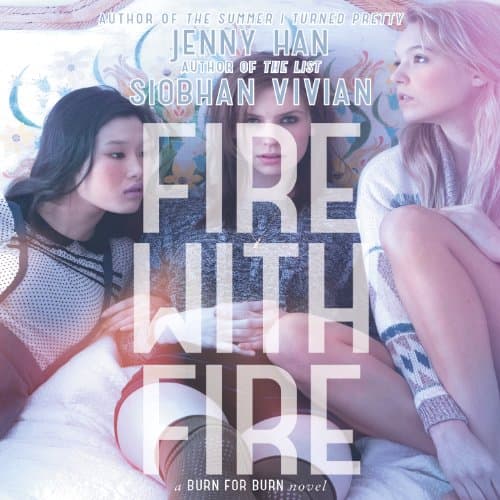

Fire with Fire is a middle book that doesn't play it safe, and the audiobook version is the reason I'm saying that with enthusiasm instead of a warning.
I started listening on a Tuesday morning walk, expecting to chip away at it over the week. By Wednesday night I was finishing it in bed with my headphones on, which is not how I usually consume YA revenge trilogies. But here's the thing—this isn't really a revenge book anymore. Jenny Han and Siobhan Vivian take the pact from Burn for Burn and let it rot from the inside out. My review of Burn for Burn covers how that pact gets established—worth reading first if you're coming in cold. Lillia, Kat, and Mary aren't scheming their way through this installment. They're dealing with what their scheming already broke, and the story is darker and stranger for it.
Mary's arc is the centerpiece, and it goes places I wasn't expecting from this series. The way her anger bleeds into everything—her memories, her relationship with Reeve, her sense of self—pushes the book out of standard teen drama territory. "He didn't just bully her—he made her love him" is the kind of line that sounds like marketing copy until the book actually unpacks what it means. It's uncomfortable. It's supposed to be.
The three-narrator setup is where the audiobook format justifies itself. Madeleine Maby voices Kat, Joy Osmanski takes Lillia, and Rebekkah Ross handles Mary. Each narrator owns their chapters completely, and the contrast between their voices creates natural momentum when the story shifts perspective.
Maby was the standout for me. Kat's humor comes through clean and confident, which is expected—that's the character. She brings that same sharp, grounded energy to Death in the Off-Season, which I reviewed a while back and keep thinking about when a narrator just completely inhabits a character. What I didn't expect was an emotional monologue late in the book where Maby drops the bravado entirely. The shift is chilling. It's one of those narrator moments where you stop walking and just stand there on the sidewalk like an idiot because the performance demands your full attention.
Osmanski plays Lillia with a lighter touch that pays off in unexpected ways. There's a scene where she voices two drunk moms, and the comedic timing is so precisely calibrated that I laughed out loud on a morning walk—which, if you've been there, you know gets you looks from dog walkers. It's a throwaway scene in the plot but it shows the level of craft Osmanski brought to every chapter.
Ross had the hardest job. Mary's storyline requires a narrator who can make you feel sympathetic and uneasy in the same breath. If you listened to the first book, you might remember an echo effect layered onto Ross's narration that felt heavy-handed. They scaled it back significantly here, and the result is a performance that feels more grounded and more disturbing for it. Ross also voices the other girls' characters when they appear in Mary's chapters, and the transitions are clean—you're never yanked out of the scene wondering who's talking.
What struck me digging through listener reactions is the near-total absence of audio complaints. No pacing issues, no pronunciation problems, no confusion about which character is speaking. For a three-narrator production, that kind of invisible craft is harder to pull off than it sounds.
The trade-off is in the story's pacing. This is a bridge between the revenge setup of book one and whatever explosion book three delivers. The plot moves slower because the focus has shifted from scheming to consequence. The friendship between these three girls—fractured, codependent, sometimes genuinely toxic—carries the weight. If you need momentum from external action, some stretches will test your patience. But the character dynamics kept me engaged even when the plot wasn't sprinting.
At eleven hours, the runtime feels earned. The three distinct narrators keep the audio dynamic, and each voice is different enough that POV switches feel like channel changes rather than interruptions.
One thing you need to know before committing: this book ends on a real cliffhanger. Not the gentle kind. The kind that made me immediately check whether the third book was available on audio. Have Ashes to Ashes ready to go, or you'll spend the rest of your evening staring at the ceiling.
If you loved the first book's setup and want to see what happens when revenge curdles into something uglier, this is your next listen. If you bounced off Burn for Burn or need standalone stories, skip this one—it's firmly a middle chapter and leans into that role without apology.
The narrators turn this into a listening experience that genuinely surpasses reading the text alone. Maby's humor and vulnerability, Osmanski's comic precision, Ross's controlled intensity—together they create something that feels close to a full-cast production, even though each narrator carries their own chapters solo. That combination is what makes this worth the credit.