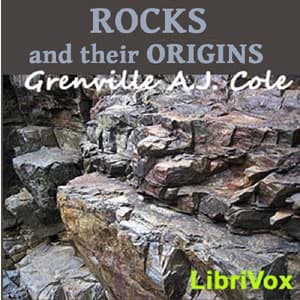

This is a geology textbook from 1922 narrated by a LibriVox volunteer, and honestly? It's the most effective sleep aid I've found since melatonin.
Let me be real upfront: I didn't set out to review a century-old geology book. I found this at 1AM after that Tuesday night deployment went sideways and my brain was still running hot from staring at Datadog dashboards. Couldn't sleep, didn't want anything demanding, and somehow this popped up in my queue. Three nights later, I've "finished" it — though I use that word loosely because I definitely drifted off during the limestone chapters at least twice.
Victorian Geology Lectures Hit Different at 1AM
Grenville Cole wrote this in 1922, and it reads exactly like you'd expect from an Edwardian-era geology professor. The prose is dense, formal, and packed with mineral classifications that blur together if you're not actively taking notes. He walks through sedimentary, igneous, and metamorphic rocks with the thoroughness of someone who assumes you're sitting in his lecture hall with a notebook. There's genuinely interesting stuff buried in here — his descriptions of how granite weathers differently than limestone, and how you can read landscape history from rock formations, gave me the same satisfaction as tracing a good stack trace back to root cause. The analogy of reading geological layers like debugging system states actually works surprisingly well.
But here's the thing: Cole was also apparently an avid cyclist who explored Irish geology on two wheels, and you can feel that passion in certain passages where he describes specific cliff faces and quarry walls. Those moments are the highlights — when he stops cataloguing mineral compositions and starts painting pictures of actual landscapes. The section on building materials where he compares limestone, granite, and marble for construction purposes is genuinely practical, even a hundred years later.
The problem is that for every moment of vivid landscape description, there are long stretches of pure chemical composition listings and classification taxonomies that were clearly meant to be read on paper, not listened to. Hearing someone narrate "silicon dioxide comprises approximately..." for the fifteenth time is... an experience.
The LibriVox Factor
J.M. Smallheer is a LibriVox volunteer narrator, and I want to set expectations accordingly. This isn't a professional Audible production. There are no sound effects, no music, no production polish. The recording quality is clean enough — no obvious background noise or technical issues that I noticed — but the delivery is straightforward and measured. Steady, even-paced, minimal vocal variation. For a book like this, that's honestly not a terrible thing. A more dynamic narrator might've kept me awake, which would've defeated my purpose. The Inquiry into the Human Mind on the Principles of Common Sense has a similar flat-but-functional LibriVox energy — another one I've used as a late-night brain cooldown with decent results.
At 3 hours 36 minutes, it's barely two commutes at my usual 1.5x speed. But I actually listened to this one at 1x. Partly because speeding up a century-old geology lecture felt wrong, and partly because — let's be honest — I was using it to fall asleep and faster narration would've undermined the whole operation.
Who Actually Wants This
There's a podcast called "Bore You To Sleep" that literally uses this book as a sleep story episode. That tells you everything you need to know about the intended use case for most people. And look, no shade — that's a legitimate use. Not every audiobook needs to be Project Hail Mary.
If you're genuinely into geology, this is a free LibriVox recording of a historically significant introductory text. The science is obviously dated — 1922 predates plate tectonics theory by decades — but the observational geology and rock classification basics are still sound. Could be interesting if you're into history of science or want to understand how geologists thought before we knew about continental drift.
But if you're looking for a modern, engaging science audiobook? Skip this. Pick up something from the last decade with a professional narrator. The ROI on this audiobook is only positive if your currency is "minutes until unconsciousness."
Perfect for: bedtime, background noise while coding. Skip for: commute (you'll miss your stop, but not in the good way — in the "you fell asleep" way).
My Sleep Stack, Ranked
I'm giving this a 2.5. It's free, it's short, the audio quality is fine, and if you want a gentle geology lecture to drift off to, it does the job. But I can't pretend this is a good audiobook experience. The source material is a hundred years old, the narration is functional but flat, and Kevin literally asked me why I was listening to "a rock documentary" at midnight. Fair question, Kevin. Fair question.






![Steve Jobs [unabridged audiobook] audiobook cover](/_next/image?url=https%3A%2F%2Fcovers.audiobooks.com%2Fimages%2Fcovers%2Ffull%2F9788499923406.jpg&w=1920&q=75)