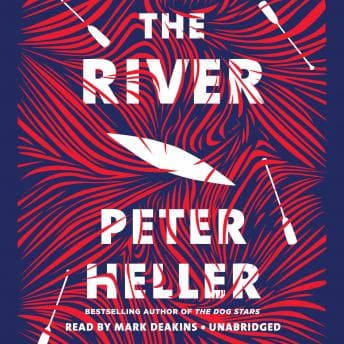

I was up at 2 AM supposedly debugging a procedural terrain generator for my thesis when I figured, you know what, let me just throw something on in the background. Seven hours later my code hadn't moved a single line forward, the sun was coming up, and I'd white-knuckled my way through the entirety of Peter Heller's The River. So much for background listening.
Here's the thing — this isn't my usual lane. No magic systems, no stat blocks, no ancient prophecies. Two college buddies, a canoe, northern Canada. That's it. And yet Heller does something I genuinely respect: he builds the wilderness the way Sanderson builds Roshar. Every portage, every rapid, every shift in wind direction feels like it matters, like it's a rule in a system you're learning. The Maskwa River isn't just a setting — it's basically the dungeon, and the wildfire closing in behind Wynn and Jack is the ticking clock your DM drops on you when the party's been dithering too long.
Two Friends, One Canoe, and a Very Bad Feeling
Wynn and Jack remind me so much of guys I grew up playing D&D with. Wynn's the gentle Vermont kid who'd play a druid and spend twenty minutes describing how he communes with a stream. Jack's the ranch-raised Colorado type — the ranger who actually knows how to start a fire and gut a fish. Heller nails the rhythm of a deep male friendship where half the communication is silence and the other half is arguing about which channel to paddle. There's this early stretch where they're just fishing and picking blueberries and reading paperback Westerns by the fire, and it's so peaceful you almost forget the book is categorized under "Action & Adventure."
Almost.
Because then they hear an argument through the fog. A man and a woman on the riverbank. They go looking. Find nothing. And the next day, a man appears on the river alone. No woman.
That's when my thesis was officially dead for the night.
Mark Deakins and the Art of the Slow Burn
Okay, so Mark Deakins isn't doing what Steven Pacey does — Pacey walked so other narrators could run, and Deakins isn't trying to sprint. He's doing something different and it works perfectly for this book. His voice is deep, almost unnervingly calm in the early chapters, which sets up this deceptive ease. You're floating along with Wynn and Jack, and Deakins's pacing is so relaxed you'd swear this is a cozy wilderness memoir.
But here's what's clever: as the fire closes in and the mystery of the missing woman escalates, Deakins doesn't suddenly shift into thriller-narrator mode. He just... tightens. The pauses get shorter. The tone drops half a register. It's subtle enough that you don't consciously notice the shift, but your heart rate does. His differentiation between Wynn and Jack is understated — slightly warmer for Wynn, a bit more clipped for Jack — which matches the comfortable friendship dynamic without turning into a voice-acting showcase. For a book this intimate, with essentially two leads for most of the runtime, that restraint is exactly right.
I've heard Deakins described as a "dream team" pairing with Heller, and having now experienced it — yeah. This is a narrator who understood the assignment.
The Wilderness as Antagonist (My DM Would Approve)
What surprised me most is how Heller handles tension without leaning on action set pieces. The fire is always there, but it's not constantly on screen. The suspicious man on the river is threatening, but ambiguously so. The real tension comes from decisions — do you portage around dangerous rapids or run them because the fire's gaining? Do you confront the lone paddler or leave it alone? It plays out like a survival scenario where every choice has cascading consequences. My D&D group would love this — it's basically a two-player campaign with a killer DM who keeps rolling random encounters.
At 7 hours and 19 minutes, it's tight. No bloat, no meandering subplots. Heller trusts the river and the fire and the friendship to carry it. And they do.
Who Paddles In, Who Stays on Shore
If you need dragons or space marines to stay engaged, this probably isn't your next listen. But if you've ever sat around a campfire and felt that primal unease when the dark gets a little too quiet — this book bottles that feeling. Fans of literary survival fiction, people who loved Into the Wild or Cormac McCarthy's quieter moments, you're going to eat this up. And honestly? Fantasy readers who appreciate world-building should give it a shot. Heller builds the Canadian wilderness with the same obsessive detail other authors spend on fictional continents. That same kind of meticulous, lived-in setting is what made Giver of Stars stick with me too — Moyes builds rural Kentucky with a specificity that feels almost anthropological, and the landscape ends up shaping the characters just as relentlessly as Heller's river shapes Wynn and Jack.
I read this instead of writing my thesis. Zero regrets.
Roll for Initiative (Against a Forest Fire)
I went in expecting a pleasant nature audiobook and came out at dawn with my pulse elevated and my thesis another day behind schedule. Peter Heller and Mark Deakins turned a canoe trip into something genuinely terrifying without ever raising their voices. The progression is satisfying — it earns its tension honestly, scene by scene, mile by mile downriver. Not everything needs to be 40 hours of epic fantasy to be worth your time. Sometimes 7 hours on a burning river is plenty.