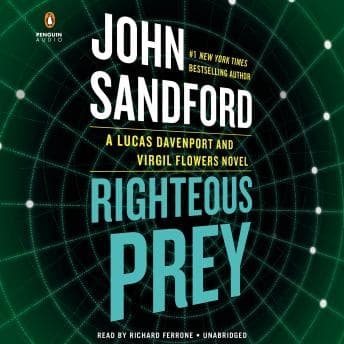

I have a confession. I've been studying the psychology of vigilante justice for a paper I'm probably never going to finish, and then this audiobook shows up like the universe is mocking my research procrastination. Rich people who murder predators and donate Bitcoin to charity? That's not just a thriller premise—that's a fascinating case study in moral licensing and the psychology of justified violence. The Silent Patient explores similar territory with psychological manipulation, though from a completely different angle.
But I'm getting ahead of myself.
The Moral Calculus That Keeps You Listening
John Sandford does something clever here that I genuinely appreciate from a psychological standpoint. The Five aren't your typical vigilantes driven by personal trauma. They're bored billionaires who've constructed an elaborate ethical framework to justify murder. And honestly? The way Sandford writes them, you catch yourself nodding along before your prefrontal cortex kicks in and reminds you that, no, murder is still murder even when the victim is objectively terrible.
This is classic moral disengagement theory playing out in real-time. The killers diffuse responsibility across the group, dehumanize their targets by focusing on their crimes, and offset guilt through charitable donations. It's textbook Bandura. (Yes, I took notes during an audiobook. Don't judge me.)
What makes this compelling is that Sandford doesn't let you sit comfortably with either side. Davenport and Flowers are hunting killers who are killing killers. Research shows audiences struggle with moral ambiguity in fiction more than we admit—we want clear heroes. Sandford refuses to give us that, and I found myself asking: why does this group really need to be stopped? The answer is more uncomfortable than the book explicitly states.
Richard Ferrone's Voice in My Head
I listened to this during my morning jogs through Cambridge, and I have to say—Ferrone's gravelly narration hits different when you're running past Harvard students at 6 AM. There's something about his voice that feels like a weathered detective is personally briefing you on a case.
The man understood Lucas Davenport. After decades narrating this series, Ferrone didn't just read the character—he inhabited him. The slight weariness in Davenport's observations, the dry humor that surfaces at crime scenes, the way authority figures sound appropriately annoyed. It's all there.
I couldn't find much about Ferrone's specific preparation process for this book, but based on this performance, he clearly internalized the character's psychological profile. The protagonist exhibits classic traits of someone who's seen too much but keeps going anyway—functional cynicism, I'd call it. Ferrone captures that without making Davenport sound burnt out or checked out. It's a fine line.
And then I learned he passed away, and suddenly those listener comments about "the series won't be the same" hit harder. There's something bittersweet about listening to what might be one of his last performances in this role.
Where the Psychology Gets Messy
Some listeners mentioned the political content being distracting, and I get it. Sandford weaves in contemporary references that might date the book or pull you out of the thriller momentum. For me, it added texture—real criminals don't exist in a political vacuum, and neither should fictional ones.
But the ending. Ugh. Without spoiling anything, it felt like Sandford spent 90% of the book building this intricate psychological chess match and then... just stopped. The resolution doesn't quite match the complexity of the setup. My therapist would have thoughts about this—specifically about how unresolved narrative tension mirrors unresolved psychological tension. But that's probably me overanalyzing. (That's definitely me overanalyzing.)
The pacing otherwise is solid. Sandford knows how to structure a procedural—each investigation step feels earned, not manufactured. The 11+ hours flew by on my runs, which is saying something because I usually zone out around hour 6 of any audiobook.
Who This Works For (And Who Should Skip)
If you're already invested in Davenport and Flowers, obvious yes. The character dynamics are well-established and Sandford doesn't waste time on exposition. New to the series? You could probably start here, but you'd miss some of the accumulated weight of their partnership.
If moral ambiguity or political commentary in your thrillers frustrates you, sample first. This isn't straightforward good-vs-evil. The killers are sympathetic. The victims are monsters. The investigators are caught in the middle. It's messy. Psychologically, that's accurate to real life, but I know not everyone wants that in their escape reading. If you prefer your thrillers more direct, something like Any Means Necessary might be more your speed—less moral ambiguity, more action.
For true crime fans who want fiction grounded in how criminals actually think—this is your lane. Sandford clearly did his homework on the psychology of organized violence.
Case Notes: Final Assessment
I finished this three days ago and I'm still thinking about The Five's justification framework. That's either a sign of a good thriller or a sign that I need to get out more. Probably both.