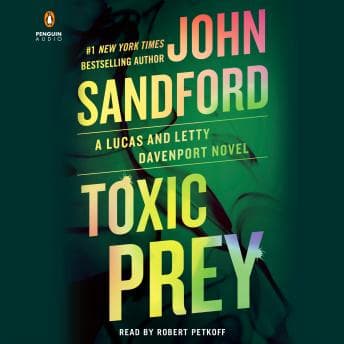

What happens when a series loses its voice? I mean that literally—Richard Ferrone narrated the Prey novels for years, and when he passed away, Sandford fans faced an uncomfortable question: could anyone else inhabit Lucas Davenport's world?
I was shelving returns at the library when I started this one, headphones in, half-expecting to hate it. Ferrone's voice was *the* voice for so many of us. But here's the thing about Robert Petkoff—he doesn't try to be Ferrone. He shows up with his own interpretation, calm and decisive, and somewhere around hour two, I stopped comparing.
The Tension Lives in the Quiet
Petkoff does something interesting with pacing that I didn't expect. Where Ferrone brought a kind of gruff intensity, Petkoff plays it cooler. Almost too cool. But that restraint? It works for *Toxic Prey* specifically. The plot involves some genuinely nasty stuff—biological threats, the kind of danger that escalates without explosions—and Petkoff's measured delivery makes the horror feel clinical. Inevitable. Like watching a countdown you can't stop.
His character differentiation is solid, particularly with Letty. She's got this dry British humor thing going on, and Petkoff leans into it without overplaying. The snappy dialogue between father and daughter actually lands, which isn't nothing. Sandford writes good banter, but banter needs timing, and Petkoff's got it.
That said—and I'm not the only one who noticed this—his British accent for certain characters sounds slightly off. Not bad enough to pull you out completely, but there's this uncanny valley quality where you can tell he's *doing* an accent rather than *being* someone with that accent. For a thriller, it's forgivable. For a character-driven drama, it might not be.
The Ferrone Ghost in the Room
Let's address this directly because the audiobook community has Feelings about it. Some listeners will never accept anyone but Ferrone. That's fair. When you've spent twenty-plus books with a voice, it becomes inseparable from the character. Petkoff is fighting an impossible battle there.
But here's my take: Petkoff is phenomenal at his job. He's won Audies. He's got the technical chops. And honestly? His calm, decisive reading style amps up the tension in ways that suit this particular book's vibe. The scenes where everything's going sideways but Lucas is thinking three steps ahead—Petkoff makes those work. Unkindness of Ravens has that same methodical tension, though the narrator there didn't quite nail the pacing the way Petkoff does here. You can hear the gears turning.
Is it the same experience? No. Is it a lesser experience? That's where I land on "different" rather than "worse." My podcast listeners are going to have opinions, and I suspect they'll split right down the middle.
Who's Going to Love This (And Who Should Skip)
If you're a Prey series completist, you already know you're listening to this. The question is whether you'll enjoy it. If you can approach Petkoff as a fresh start rather than a replacement, you'll probably be fine. He keeps the pace tight—eleven hours moves fast when you're not checking how much is left.
If you're new to Sandford? Actually, this might be a decent entry point. You don't have the Ferrone attachment, so you can just... experience the book. And Sandford knows how to write a thriller. The man's a Pulitzer winner for a reason (journalism, but still). That same competence-without-arrogance thing is what makes Head Full of Ghosts work so well—characters who feel real even when the stakes get supernatural. Lucas Davenport is the kind of protagonist who's competent without being insufferable, and that's harder to write than it sounds.
Skip if: you need your thrillers with more pyrotechnics. This is methodical. It's about smart people doing smart things under pressure. If you want car chases and explosions, look elsewhere.
Closing Up the Stacks
I finished this one while closing up the library—empty building, just me and the fluorescent lights humming. Appropriate, honestly. *Toxic Prey* is the kind of thriller that works best when you're a little isolated, a little on edge. Petkoff's narration won't make you forget Ferrone, but it won't make you regret the eleven hours either.
Shirley (my cat) was unimpressed when I came home still processing the ending. But she's unimpressed by everything that isn't wet food, so that tracks.
Sandford delivers exactly what you expect from a Prey novel—tight plotting, competent protagonists, stakes that feel real without feeling cheap. Petkoff delivers a performance that honors the series while making it his own. Is it perfect? No. But it's good. And sometimes good is exactly enough.