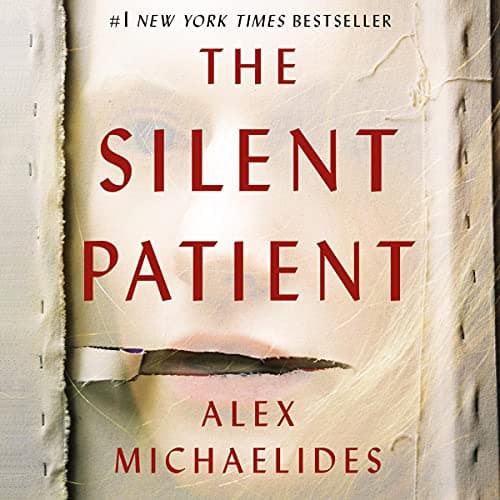

I started this one at 11 PM with a stack of junior essays beside me and the particular kind of fatigue that makes bad decisions feel reasonable. "Just one chapter," I told myself. A lie. By the time Theo Faber was making his way into the Grove, that secure forensic unit in North London, I had stopped pretending I was going to grade a single paper. Worth pausing the faculty meeting for. Worth ignoring comma splices for, too.
The setup is nasty in the best way: Alicia Berenson, a famous painter with the seemingly enviable London life - grand house, big windows, handsome photographer husband - shoots Gabriel five times in the face and then never speaks again. Not for the police. Not for the public. Not for the therapists circling her silence like sharks who went to graduate school. That premise alone is sharp enough to sell the book, but what kept me listening was the way Alex Michaelides turns silence into performance, punishment, and bait all at once.
The kind of silence that accuses
This book understands that muteness can be louder than confession. Alicia's refusal to explain herself doesn't just create mystery; it creates an industry. Her art skyrockets in value. Her case turns into public spectacle. Everybody wants her to mean something. That's smart, and a little ugly, and very true.
Then in walks Theo, a criminal psychotherapist who is supposed to be helping her but is also, very clearly, trying to solve her. Jack Hawkins leans into Theo's intelligence without sanding off the desperation underneath it. And that matters, because Theo is the kind of character who could easily become insufferable - one of those men who mistakes obsession for insight. Hawkins doesn't excuse him. He lets you hear the self-justification as it forms. The little pushes of certainty. The way compassion and vanity start sounding uncomfortably similar.
That's what works here. The book isn't only asking, "Why did Alicia do it?" It's also asking, "Why does Theo need the answer so badly?" As an English teacher, this is the part that interested me most. Let's talk about what the author is really saying: not all interpretation is generous. Sometimes interpretation is conquest with better vocabulary.
And yes, the twist is real. I'm not going to spoil it, because I'm a teacher, not a monster. But I will say this: the ending doesn't just try to surprise you; it reassigns moral weight. That's harder to pull off.
Two voices, one locked door
Louise Brealey has the trickier assignment, I think, because Alicia's whole identity in the novel is built around what she withholds. A lesser performance would've tried to "sell" the emotion too hard. Brealey doesn't. She uses restraint like a scalpel. When Alicia is heard in her earlier, happier life, there's warmth there - enough that you feel the loss of it later. And when the story moves into anguish, Brealey never overplays it. The narrator understands that pause is punctuation. In a book where the title character is defined by silence, those measured hesitations do a lot of heavy lifting.
Hawkins, meanwhile, gives Theo a controlled, forceful edge that fits the character's profession and his ego. He sounds like a man who has spent years explaining other people to themselves and has gotten a little too comfortable hearing his own framework echoed back. That self-possession starts to fray as the book goes on, and Hawkins tracks that unraveling well.
The dual narration was absolutely the right call. Not because it's flashy - there are no sound effects, no production gimmicks, no "look what audio can do" nonsense - but because these are two very different forms of confinement. Alicia is trapped inside silence. Theo is trapped inside narrative. Giving them separate voices lets you feel that contrast in your bones.
One more thing I appreciated: the accent work for the book's Greek and Latvian edges doesn't clang. That sounds like faint praise until you've heard enough audiobooks where one bad accent yanks you clean out of the story. Not here. Clean production, steady pacing, no audio irritations. Just actors doing the job.
Where it hooked me - and where it may lose some people
This is a binge listen, but not because it sprints. It doesn't. It coils. There's a difference. Some listeners get frustrated with Theo, and I get that. I did too, at moments. He can feel passive in the way certain literary investigators often do - forever noticing, circling, revising, staring into the middle distance while someone else withholds the crucial thing. My students would hate this. I love it.
Because the passivity is part of the design. Theo thinks he is penetrating a mystery at the Grove, but the novel keeps asking whether he is actually drifting toward one he's already built for himself. That gives the middle stretch a charged, uneasy feeling even when the plot isn't firing off revelations every five minutes.
Still, this is worth saying plainly: if you want a thriller that throws a body through a window every forty pages, this isn't that book. It's more controlled than that. More psychological. More interested in the stories people compose after violence than in violence itself.
And that title? It earns its keep. "Silent patient" sounds clinical, almost cold. But the book keeps complicating the phrase. Is Alicia silent because she cannot speak, will not speak, or has decided that speech itself is a kind of surrender? The old question remains the same, and the better modern thrillers know it: what do people hide, and what does hiding cost?
Who Should Listen (And Who Should Skip)
If Gone Girl made you happy in that slightly ashamed way, if you like novels where the reveal forces you to reconsider the storyteller rather than just the crime, this is for you. If you loved The Girl on the Train but wanted a cleaner structure and stronger control of atmosphere, this might be its cooler, more disciplined cousin.
Skip it if you need nonstop action, or if "therapist with a mess of his own" already makes you tired. Fair enough. I will say that readers craving pure momentum might burn through Clive Cussler Fire Strike faster and with less existential unease, which is sometimes exactly what you need at 11 PM with a stack of ungraded essays.
For me, this landed exactly where a good psychological thriller should: that unnerving space where motive becomes performance, confession becomes power, and silence starts sounding like the most aggressive act in the room. I finished it staring at a half-graded essay and thought, well. Nobody in sophomore honors is getting feedback tonight.