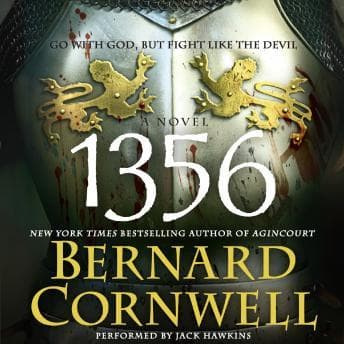

"He who fights and runs away..." No, that's not Cornwell. But somewhere around hour three, Thomas of Hookton is knee-deep in French mud with a handful of mercenaries who'd sell their own mothers for a warm meal, and I caught myself thinking: this is what Hemingway meant when he talked about writing one true sentence. Except Cornwell writes about six hundred of them, and every one lands like an English longbow shaft at two hundred yards.
I was listening to this on a Saturday morning walk along the lakefront with Denise, and she finally pulled one of my earbuds out around the Michigan Avenue turn because apparently I'd been narrating the battle formations out loud. To strangers. I regret nothing.
The Hundred Years' War Has No Business Being This Personal
Here's what Cornwell does that most historical fiction writers don't even attempt: he makes the macro feel micro. The Battle of Poitiers - September 19, 1356, English outnumbered, French overconfident, the whole thing historically improbable - could easily become a textbook exercise. Instead, Cornwell plants you in Thomas of Hookton's boots and makes you smell the horse sweat and hear the arrows singing overhead. Thomas is back from the Grail Quest series, older now, leading a ragtag band of fighters who are half soldiers, half con men. The political intrigue threads - the maneuvering, the betrayals, the people who smile at you while sharpening their knives behind their backs - give the story a spine that the battle scenes hang from like armor on a rack.
But here's the thing I keep turning over: some of the characters beyond Thomas feel like chess pieces. You can almost see Cornwell moving them into position for the big set piece. The French nobility, the various schemers - they serve the plot faithfully, but I never quite felt that gut-punch attachment to anyone beyond Thomas and maybe two others. My students would call this "mid character development." I wouldn't go that far, but I understand the complaint. If you loved Agincourt, you'll find this is its spiritual successor - same DNA, same brutal honesty about medieval warfare, but Agincourt had a tighter emotional core. I had a similar feeling reading Golden Son - that sense of a sequel that expands the world impressively but trades some of the original's emotional punch for sheer scale.
Where 1356 absolutely sings is the battle itself. Cornwell builds to Poitiers the way a great symphony builds to its final movement. The last three hours are relentless. The prose deserves to be savored - the way he describes the English line holding, the French cavalry breaking, the impossible capture of King John II. This is why we still read the classics of the genre. The man knows how war works on paper better than anyone writing today.
Jack Hawkins and the Accent Tightrope
Let's talk about what Jack Hawkins brings to this. His accent work is legitimately impressive - switching between English, French, and various regional European voices with a confidence that sells the medieval melting pot of the Hundred Years' War. His English characters carry a gruff, common edge while his French aristocrats drip with that particular brand of entitled disdain that makes you want to reach through your earbuds and slap them. During the battle sequences, Hawkins ramps up the energy in a way that had my heart rate climbing on that lakefront walk.
But - and I say this with genuine respect for the performance - there are moments where his pacing stumbles. The narrator understands that pause is punctuation, but sometimes his cadence flattens during the connective tissue scenes, the political conversations and travel sequences between set pieces. A couple of pronunciation choices made me wince (the kind of thing where you can't unhear it once you notice, though I'll spare you the specifics because I'm an English teacher, not a linguist, and I've been wrong about pronunciation before). These aren't dealbreakers. They're speed bumps on an otherwise solid ride. I'd put Hawkins at a strong but not flawless performance - he clearly knows Cornwell's world, and his battle narration alone earns his keep.
Who This Is Actually For (And Who Should Walk Away)
If you're a Cornwell loyalist, you already own this. If you're new to him, 1356 works as a standalone - you don't need the Grail Quest books, though they'll deepen the experience. History nerds who want their medieval warfare accurate and visceral? This is your twelve hours well spent. But if you need deep emotional investment in a wide cast of characters, or if inconsistent narrator pacing drives you to distraction, temper your expectations. This is a plot-driven war novel first, character study second.
I listened at 1.0x, because Cornwell's battle choreography demands it. You speed this up and you'll miss the tactical details that make the payoff work.
Worth Pausing the Faculty Meeting For
Cornwell at his martial best is still better than most writers at their anything. 1356 isn't his tightest novel - there's about ninety minutes of mid-book setup that tested even my patience, and I've assigned Middlemarch to eleventh graders. But when it hits, it hits like a mace to the sternum. The Battle of Poitiers sequence alone justifies the listen. Hawkins delivers a performance that's energetic where it counts and only occasionally uneven where it doesn't. My students would hate this. I love it. Mostly.