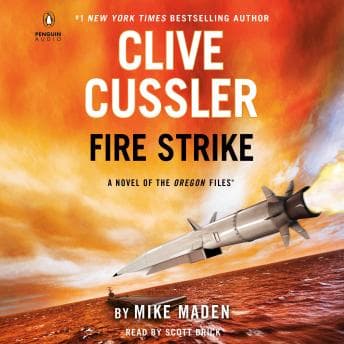

"The Oregon team must journey from the Amazon rainforest to an abandoned monastery in Eritrea before a final showdown in the mountains of Yemen."
I read that sentence from the book description around hour three, and I thought—this is either going to be gloriously ridiculous or just ridiculous. Denise was already asleep beside me, and I was grading sophomore essays on The Great Gatsby while Scott Brick described bio-hacked super soldiers with "unquenchable appetites for violence." Fitzgerald, forgive me.
But here's the thing. Sometimes you don't want Faulkner. Sometimes you want a ship called the Oregon that's secretly a floating weapons platform, crewed by people with names like Juan Cabrillo who solve international crises by shooting things. That same unapologetic energy powers Hot Ice, though with more jewel heists and less hypersonic weaponry. My students would absolutely devour this. I'm not sure what that says about my students.
The Ghost at the Typewriter
Let's address what everyone's thinking but nobody wants to say directly: Clive Cussler died in 2020, and Mike Maden is writing these now. The reviews are split—some folks feel something's missing, that ineffable Cussler thing that made the originals work. One listener said it felt like "a different person wrote each chapter," which is brutal but not entirely unfair.
I've been teaching long enough to recognize when a student is imitating a writer's style versus actually understanding their voice. Maden is clearly competent—the Jack Ryan Jr. novels prove that. But there's a patchwork quality here, moments where the prose shifts gears unexpectedly. Whether that bothers you depends entirely on why you're here. If you're chasing the ghost of original Cussler, you might leave disappointed. If you want fourteen hours of hypersonic missiles and genetically enhanced mercenaries, well. Pull up a chair.
Scott Brick Knows the Assignment
I'm going to say something controversial for an English teacher: sometimes the narrator matters more than the prose. Scott Brick understands this completely. His voice has that resonant, authoritative quality that action thrillers require—you believe him when he's describing a Saudi Prince's apocalyptic schemes because he sounds like someone who's seen some things.
What impressed me most was the character differentiation. Cabrillo and his crew are a diverse bunch—the Oregon is essentially a floating United Nations of badasses—and Brick keeps them distinct without resorting to cartoonish accents. The heroic roles get subtle variations, enough that by hour six you know who's speaking before the attribution tag. That's craft. That's the narrator understanding that pause is punctuation, that voice modulation is characterization.
No mispronunciations that I caught. No pacing issues. Clean audio throughout. For a fourteen-hour commitment, that consistency matters.
Kenya to Amazon to Eritrea to Yemen (Buckle Up)
Bio-hacked soldiers. A hypersonic missile. A Saudi Prince with genocidal ambitions. Israel in the crosshairs. The Arabian Sea becoming "a mass grave."
This is not subtle. This is not trying to be subtle. Hemingway said you should know what you're leaving out. Maden knows exactly what he's leaving out: nuance, moral ambiguity, quiet moments of reflection. What remains is pure propulsion. The geography alone is exhausting.
I found myself mentally mapping the action sequences like I map essay structure for my students. Setup, escalation, climax, brief resolution, immediate new threat. Repeat for fourteen hours. It works because it's not pretending to be anything else. The prose deserves to be—okay, not savored, but consumed efficiently. Like a good airport meal.
Who Should Queue This Up (And Who Should Skip)
If you loved the original Oregon Files and can accept that Cussler's name is now more brand than author, you'll find enough here to justify the credit. If you're new to the series, honestly? This works fine as a standalone action romp. The bio-hacked soldiers are genuinely menacing, the stakes are appropriately apocalyptic, and Brick's narration elevates material that could easily feel generic.
Skip if: you're looking for literary fiction, you can't suspend disbelief about genetically enhanced mercenaries, or you're the kind of person who gets annoyed when books treat geopolitics like action movie set dressing. (Principal Martinez would probably love this, actually. I should recommend it at the next faculty meeting I'm definitely paying attention to.)
Worth Pausing the Grading For
Look, I'm not going to pretend this changed my life or taught me something profound about the human condition. But at 11 PM, with a stack of essays still ungraded and my wife breathing softly beside me, Scott Brick's voice carried me through fourteen hours of explosions and international intrigue. Sometimes that's enough. Sometimes you need the literary equivalent of a really good action movie—competent, propulsive, utterly unconcerned with being Important.
My students would love it. I didn't hate it. For a Cussler continuation novel, that's probably the highest compliment I can offer.