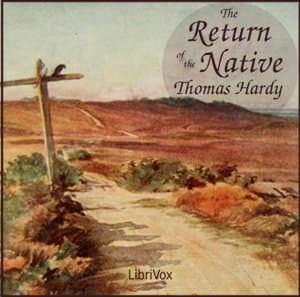

Look, I need to get something off my chest before we even start: Thomas Hardy did not write The Return of the Native so that someone could mispronounce "Grandfer Cantle" in a deep bass while the text explicitly tells us the man has a high, reedy voice. That's not a quibble. That's a reading comprehension issue. And I say this as someone who has spent two decades watching seventeen-year-olds butcher Hamlet's soliloquy - I have a high tolerance for imperfect delivery. But Hardy's Egdon Heath deserves better than that.
I listened to this LibriVox recording across a long, gray week of faculty meetings and late-night grading sessions, and I want to be fair. This is a free recording by volunteers who love literature enough to sit in front of a microphone and read Victorian prose aloud. That matters. That counts for something. But loving a book and performing a book are two very different acts, and this recording reminded me of that distinction roughly every time a new chapter reader rotated in.
Egdon Heath Deserves a Single Voice
Here's the thing about The Return of the Native that makes a multi-reader LibriVox recording particularly painful: Hardy's entire opening is a slow, almost geological meditation on Egdon Heath itself. The heath isn't setting - it's character. It's practically the protagonist. Hardy spends pages making you feel the weight of that landscape pressing down on every human decision in the story. The prose deserves to be savored, and it demands consistency. You need one voice building that atmosphere brick by brick, not a rotating cast that shifts from a measured British baritone to a flat American reading style between chapters.
The inconsistency is the real problem. There's a British male reader who appears in the later chapters - I don't know his name, but whoever he is, he understood something essential: Hardy's sentences have their own internal music, and if you rush them, you lose the meaning. His intonation was clean, his pacing let the language breathe, and for a stretch of hours I actually forgot I was listening to a volunteer recording. Then a new reader would appear, speed through a passage like they were trying to catch a train, and the spell would break.
Eustacia Vye and the Problem of Pace
Let's talk about what Hardy is really saying with Eustacia Vye, because she's the reason this novel still matters 146 years later. She's trapped - not by poverty or abuse but by geography and boredom and the specific cruelty of being an ambitious woman in a place that has no use for ambition. She's awful and magnetic and self-destructive and deeply, uncomfortably human. Hardy writes her with a kind of furious sympathy that Victorian readers absolutely were not ready for.
The problem with an uneven audio production is that Eustacia's scenes need tension. Her conversations with Wildeve, her manipulation of Clym Yeobright, her slow unraveling - all of this runs on pacing and emotional pressure. When a reader rushes through her dialogue or flattens Hardy's indirect free style into monotone, you lose the psychological weight. And without that weight, Eustacia just seems petty rather than tragic. My students would probably think she's petty anyway. But Hardy didn't, and the narration should honor that.
This reminds me of what Hemingway said about prose being architecture - Hardy's architecture here is heavy stone, cathedral-like, and it requires a narrator who feels the load-bearing walls. Some of these readers found them. Others walked right through.
The Free Audiobook Bargain
I want to be honest about the math here. This is a free recording. Seventeen and a half hours of Hardy, read by people who volunteered their time and their voices. The audio is clean enough - no weird background noise, no technical disasters. If you're a student or a reader on a budget who wants to experience this novel, it will get you there. You'll understand the plot, the characters, the themes. The American accent issue that some listeners complain about didn't bother me as much as the pacing problems did. (Though I'll admit - and Denise would back me up on this - hearing Hardy's Dorset characters rendered in a flat Midwestern cadence is... a choice.)
But if you care about performance as interpretation - if you believe, as I do, that a narrator's pause is punctuation, that the rhythm of delivery shapes meaning the way a conductor shapes an orchestra - then this recording will frustrate you. It gave me enough good moments to keep listening, and enough jarring transitions to make me wince.
Worth Pausing the Faculty Meeting For?
The novel itself? Absolutely. This is why we still read the classics - because Hardy was asking questions about fate versus choice, about whether we're shaped by our landscape or imprisoned by it, that we still don't have good answers to. The Return of the Native is the spiritual predecessor to every literary novel about someone going back to a small town and discovering they can't escape it. If you loved Stoner by John Williams, this is its spiritual ancestor. That same suffocating weight of place and thwarted ambition shows up in Dispossessed: A Novel too, though Le Guin transplants it to an entirely different world — and somehow makes it feel just as inescapable.
But this particular recording? It's a mixed bag held together by a few genuinely good volunteer readers and Hardy's own indestructible prose. I'd point anyone who can afford it toward a professional recording instead. For a free option, though, it does the job - just unevenly. Listen at 1.0x for the good readers. For the fast ones, honestly, you might want to slow it down to 0.9x just to let Hardy's sentences land.