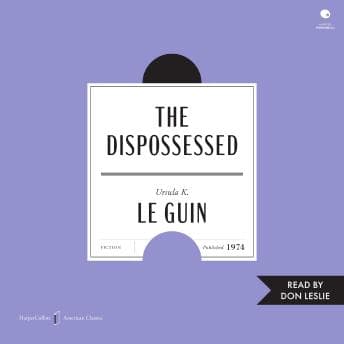

What if the revolution succeeded—and then calcified into exactly what it was fighting against?
That question rattled around my head for three straight commutes after finishing The Dispossessed. I started this one on a Monday at 6:15 AM, half-conscious on a packed Caltrain, and by Wednesday I was so deep in Shevek's philosophical crisis that I missed my stop. Twice. In the same week.
The Dual Timeline That Shouldn't Work (But Does)
Le Guin pulls this structural trick where chapters alternate between Shevek's past on Anarres (the anarchist moon) and his present on Urras (the capitalist planet). On paper, this sounds like a recipe for confusion—especially in audio format where you can't flip back to check which timeline you're in. But here's the thing: the contrast is so sharp that your brain calibrates within seconds. Anarres chapters feel sparse, communal, almost ascetic. Urras chapters drip with sensory excess—food, wealth, academic politics.
The physics subplot is legitimately interesting if you're into that sort of thing (and I am—distributed systems engineer, remember?). Shevek's working on a unified temporal theory that would enable ansible communication—instantaneous messaging across space. It's basically TCP/IP but for the universe. Le Guin doesn't handwave the science; she makes you feel the intellectual labor of paradigm-shifting discovery.
Don Leslie's Voice: Feature or Bug?
Okay, here's where I have to be honest. Don Leslie has this deep, warm, ponderous voice that fits the cerebral tone perfectly—when Shevek is monologuing about the nature of time or the failures of revolutionary societies. The pacing is deliberate. Slow, even. And for a 13+ hour listen at 1x speed? That's a commitment.
I bumped it to 1.5x around hour four and never looked back.
The weakness—and it's a real one—is character differentiation. Leslie's voice is so consistently deep and measured that dialogue-heavy sections get muddy. There's a scene where Shevek is arguing with multiple physicists at a university dinner, and I genuinely lost track of who was speaking. The lack of clear pauses between speakers doesn't help. For a book this dialogue-heavy, that's frustrating.
But here's my counterargument to the haters: maybe the sameness is... appropriate? Shevek spends the whole novel feeling alienated, struggling to distinguish friend from enemy, unsure who's manipulating him. The audio experience mirrors his isolation. (Or maybe I'm just rationalizing because I really loved this book.)
Basically Atlas Shrugged for Anarchists
Except it's actually good. And Le Guin is smart enough to show the flaws in both systems.
Anarres, the anarchist utopia, has become rigid and conformist—enforcing "sharing" through social shame, crushing individual genius in the name of collective good. Urras, the capitalist planet, offers Shevek freedom and resources but expects him to become a weapon. Neither society is the answer. Le Guin isn't selling you ideology; she's stress-testing it.
This is the opposite of those business audiobooks that could've been blog posts. Every chapter earns its runtime. The ideas layer on each other—property, time, walls (physical and metaphorical), what we owe each other, what freedom actually costs.
Best For: Long Commutes Where You Can Actually Focus
This is NOT a background listen. Don't put this on while debugging code or doing dishes. The prose is dense, the ideas are dense, and Leslie's pacing demands attention. I tried listening during a particularly gnarly on-call incident and retained absolutely nothing.
But for a dedicated commute where you're just sitting there anyway? For a long flight? For insomnia at 2 AM when your brain won't stop spinning? (Been there.) This is ideal. It's the kind of book that makes you feel smarter for having engaged with it.
Skip this if: you want action, aliens, or space battles—wrong Le Guin book. For that kind of hard sci-fi adrenaline, Project Hail Mary delivers in spades. Try Left Hand of Darkness instead. If you need distinct character voices to follow dialogue, you might struggle here. And if you're looking for answers rather than questions, this will frustrate you. Le Guin doesn't tell you what to think. She just makes you think.
The ROI Calculation
Thirteen hours for a Hugo, Nebula, AND Locus winner that's been reshaping how people think about political systems since 1974. The narration has real limitations, but the source material is so strong it carries. I've already recommended this to Kevin (who will never listen to it) and two coworkers (who might).
At 1.5x speed, I finished this in about 9 hours of actual listening—roughly a week of commutes. Worth it. The ideas have been debugging themselves in my head ever since.