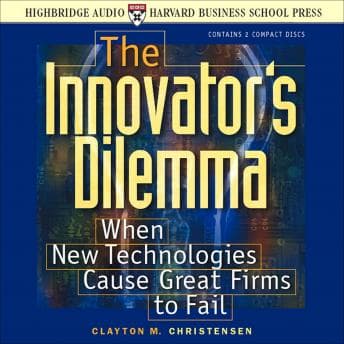

Everyone and their MBA professor has told you to read this book. It's on every "Essential Business Books" list since 1997. The framework has been cited in approximately ten thousand pitch decks. And here's the thing—they're not wrong. Christensen's core insight genuinely changed how I think about why good companies die.
But this audiobook? My 2.0x speed couldn't save this one.
The Framework That's Worth More Than Most MBAs
Let me give you the bottom line first: Christensen's central thesis is that successful companies fail precisely because they're well-managed. They listen to customers, invest in profitable products, and pursue larger markets—all the things business school teaches you. And that's exactly what kills them when disruptive technology shows up.
The disk drive industry examples are genuinely brilliant. Watching 14-inch drives get disrupted by 8-inch, then 5.25-inch, then 3.5-inch—each time the incumbents saw it coming and still couldn't respond—that's the kind of pattern recognition my parents would've appreciated. They watched Korean grocers in LA get disrupted by big box stores doing the same thing. No HBS case study, just survival instincts that Christensen finally put into academic language.
The key takeaway is worth the listen. The other 7 hours? Not so much. Except here's the good news—this is the abridged version at 2 hours 22 minutes. Someone already did the cutting for you.
Don Leslie Reads This Like a Compliance Training Video
I was finishing this at 11 PM, prepping for a client meeting the next morning. Perfect use case, right? Quick business classic refresher. Except Don Leslie's delivery nearly put me to sleep three times. And I was standing at my kitchen counter.
Here's the specific problem: Leslie reads this like he's narrating mandatory HR training. Dry, monotone, zero variation. When Christensen describes the catastrophic failure of established steel companies—companies that did everything right and still got destroyed by minimills—Leslie delivers it with the same energy as reading a grocery list. The drama is in the content. The narrator missed the memo.
I've listened to enough audiobooks to know when a narrator is phoning it in. This isn't phoning it in—it's more like Leslie was actively trying not to engage. One listener said they "easily lost" attention, and yeah. That tracks. I had to rewind three times during the pharmaceutical industry section because my brain just... wandered.
What My Parents Did Instinctively (Now It Has a TED Talk)
Here's why I can't dismiss this book despite the narration issues: Christensen explains something I watched happen in real time. My parents' dry cleaning business in Koreatown operated on razor-thin margins, took every small job the big chains wouldn't touch, and slowly built capacity. Classic disruptive innovation playbook. They didn't have the vocabulary, but they had the instincts.
The book's framework for evaluating whether your company is vulnerable to disruption—that's genuinely useful. The questions about whether you're over-serving customers, whether there's a "good enough" product emerging below you, whether your best customers are actually leading you toward a cliff—I've used these in three different client engagements.
But I've also seen this fail at three different companies. Not because the framework is wrong, but because knowing you're being disrupted and actually doing something about it are completely different problems. Christensen acknowledges this, to his credit. The book doesn't pretend there's an easy solution.
Skip to Chapter 5. Thank Me Later.
Seriously. The first four chapters establish the framework with extensive disk drive industry analysis. Valuable if you're writing a thesis. Less valuable if you need actionable insight by your Monday morning meeting. Chapter 5 is where Christensen gets into the "what do you actually do about this" territory.
The abridged format helps here—someone already trimmed the fat. But even at 2.5 hours, there's padding. The repetition of examples, the academic hedging, the "as we discussed in the previous chapter" callbacks that make sense in print but feel redundant in audio. If you want frameworks without the academic bloat, Financial Freedom delivers actionable insight with zero fat.
The ROI Calculation
Here's my honest take: the concepts in this book are essential. The audiobook format with this narrator is not. If you've never encountered Christensen's ideas, you need them. But you might be better served by the countless summaries, the Harvard Business Review articles, or just reading the print version where you can skim.
Jenny would say I'm being harsh. Jenny is right. But I'm also right. The ideas are 5-star material that changed business thinking. This specific audio production is 3-star execution that makes absorbing those ideas harder than it needs to be.
Who should listen anyway? Founders who need to understand why their well-funded competitors might be vulnerable. Executives at established companies who wonder why they keep getting blindsided. Anyone who's been told "just focus on your best customers" and felt something was off about that advice.
Who should skip? Anyone already familiar with the framework. Anyone who needs engaging delivery to stay focused. Anyone who has the print version—just read it instead.
A business book that respects your time—at least in duration. The content-to-insight ratio is solid. The delivery just makes you work for it.