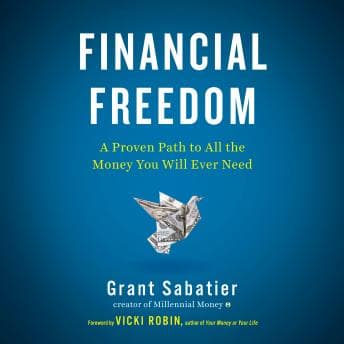

I was staring at a client's burn rate spreadsheet at 2 AM—the kind where the numbers are red enough to trigger a seizure—when I decided I needed a break. Not a sleep break, but a "remind myself why I grind" break. I queued up Sabatier's Financial Freedom while pacing around my home office. My parents would have loved the premise: work hard, save everything, buy your freedom. But ten minutes in, I felt like I was being interrogated by a valley girl.
The Math Actually Checks Out
Here's the thing: the content is solid gold. Sabatier isn't just preaching the standard "skip the latte" gospel that makes most financial consultants roll their eyes. He goes hard on the "enterprise value" of your life. The core thesis—that money is unlimited but time is not—is the kind of obvious truth we ignore until we're 60. He details his jump from having $2.26 in his bank account (a number so specific it hurts) to a net worth of over $1.25 million in five years.
He attacks the income side of the equation, which is where most budget books fail. My dad didn't retire early because he focused on saving pennies; he worked until he dropped because he didn't know how to scale his income. What It Takes wrestles with the same uncomfortable truth from the other side—Schwarzman built Blackstone on income scaling, and watching him describe that obsession made me think of my parents in a way I wasn't prepared for. Sabatier breaks down side hustles, domain flipping, and aggressive investing with the kind of tactical precision I usually charge $500 an hour to deliver. If you actually do what he says, the ROI on this audiobook is infinite.
The Audio "Up-Speak" Struggle
But we need to talk about the delivery. Sabatier narrates this himself, and it's a classic case of "should have hired a pro." He has a severe case of "up-speak"—high rising terminal. He ends about 90% of his declarative sentences with an upward inflection? Like he's asking a question? Even when he's stating a hard fact about compound interest?
It sounds like he's constantly seeking validation for his financial decisions. "So I started a digital marketing agency? And I made money? And I saved it?" By hour two, my brain was trying to answer him. "Yes, Grant, you did. We know. Please stop asking me."
I cranked the speed to 2.5x. Usually, I do this for efficiency, but this time it was self-defense. The speed flattened out the intonation curves enough to make it listenable. If you have sensitive ears, this might be a dealbreaker.
The Vicki Robin Factor
Vicki Robin, the OG of the financial independence movement (co-author of Your Money or Your Life), reads the foreword and pops in. It's a nice touch—like the grandmother of FIRE giving her blessing to the new generation's aggressive tactics. Her voice is grounded, calm, and blissfully statement-oriented. It creates a stark contrast to Sabatier's caffeinated questioning tone.
Who Should Listen (And Who Should Skip)
This is for the income-focused grinders who want tactical plays, not another "cut your cable" lecture. Skip it if vocal quirks drive you up a wall and you refuse to touch the speed controls.
Bottom Line
If you can get past the vocal tic, the roadmap is legitimate. This isn't passive income fantasy; it's a grind manual. I've seen startups burn through millions with less strategy than Sabatier applies to his personal checking account. Jenny would tell me to be nicer about the narration, but Jenny didn't have to listen to 10 hours of questions that weren't questions. Buy it for the math, speed it up for your sanity.