
How many decisions have you made before you were old enough to understand what they'd cost you?
I was sitting in the faculty lounge during lunch, headphones in, pretending to review lesson plans while the rest of the department argued about standardized testing. And Jacqueline Woodson's Red at the Bone hit me somewhere between my sternum and the stack of ungraded essays in my bag. Under four hours long. I listened to the whole thing in essentially one sitting — started at lunch, finished while Denise was already asleep — and I'm still turning it over in my head days later.
A Novel That Teaches Like Poetry Does
Here's the thing about Woodson. She writes prose the way my best students write when they finally stop trying to impress me and just say something. Spare. Deliberate. Every sentence carrying weight it has no business carrying at that word count. Red at the Bone is barely four hours, but it covers generations — the Tulsa Race Massacre of 1921, Brooklyn gentrification, teenage parenthood, queer identity, class aspiration — and none of it feels rushed. None of it feels like a Wikipedia summary dressed up in fiction.
The book moves backward and forward in time the way memory actually works. Not linear. Not polite. You're at sixteen-year-old Melody's coming-of-age ceremony in a Brooklyn brownstone, Prince playing, this custom dress that was originally made for her mother Iris — for a ceremony Iris never got to have because she got pregnant at fifteen. And then you're decades earlier, and you understand what that dress means, what it cost, who stitched ambition and grief into its seams. Woodson doesn't explain the symbolism. She trusts you. As a guy who spends his days begging juniors to stop writing "this symbolizes" in their essays, I respect that enormously.
Woodson belongs in that conversation with the permanent names — not because a syllabus says so, but because she earns it on every page. She's doing what Toni Morrison did, what James Baldwin did, but in her own compressed, almost haiku-like register. Hand this to my juniors and most would bounce off the quiet. The three who read poetry on purpose would underline half of it. Those are the readers I write for anyway.
Five Voices, One Bloodline
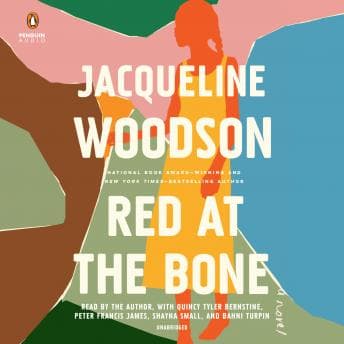
The audiobook uses a full cast, and the choice is smart because the novel itself shifts perspective between characters. Bahni Turpin voices Melody, and she does something specific I want to talk about: she uses breath. Voice breaking. Actual sighing. Not the performative kind you hear in bad audio dramas, but the kind that communicates what it feels like to be sixteen and carrying the weight of everyone else's expectations before you've figured out your own. When she's narrating Melody's sections, you feel the uncertainty in her pacing — the way a teenager talks when they're working something out in real time.
Jacqueline Woodson narrates portions herself, and there's a quote I keep coming back to where she said that while listening back, she "forgot it was me I was listening to." That's either the highest compliment you can pay an audiobook production or a sign that you've truly surrendered to your own story. Maybe both.
Peter Francis James brings Po'Boy to life with a warmth that feels earned rather than performed. Quincy Tyler Bernstine's Sabe carries the generational trauma — the Tulsa thread — with a gravity that never tips into melodrama. And Shayna Small as Iris captures something I found devastating: a young woman who chose ambition over motherhood and doesn't fully apologize for it, but doesn't fully escape the cost either. A cast this size could crowd a book this small — instead, every one of them knows when to get out of the way and let a moment breathe.
At 1.0x — and please, listen at 1.0x — this is a book that only works at its own speed. Skimming these sentences for plot misses the point; the white space is doing half the work.
Who Needs This Book (And Who Doesn't)
If you want plot-driven narrative with twists and cliffhangers, this isn't your book. There's no mystery to solve. The "twist" is just life — the way choices ripple across decades, the way class and race and desire intersect in ways nobody plans for. If you loved Another Brooklyn or if Morrison's Sula ever gutted you, this is its spiritual successor. Compact, fierce, uninterested in holding your hand. Rush carries some of that same unsparing quality — another short novel that trusts its reader to sit with discomfort rather than explaining its way out of it.
Parents will feel this differently than non-parents. Teachers will feel it differently than everyone else. I kept thinking about my students — the ones making choices right now that they can't yet understand the weight of. The ones whose parents made choices for them before they were born.
The four-hour length makes it dangerous for a credit if you're purely calculating cost-per-hour. But let's talk about what the author is really saying: some stories don't need length to leave a mark. This one followed me around for days afterward, which is more than most twenty-hour listens can claim.
The Red Pen Says: Use a Credit Anyway
I'm giving this a strong recommendation despite the short runtime because the audio production elevates an already excellent novel into something you experience rather than consume. The cast doesn't just read the book — they interpret it. That's performance art. Five narrators for under four hours sounds like overkill on paper, but each voice carries a distinct generational register that you'd lose reading silently. This is one of those rare audiobooks where the format isn't just convenient — it's the better way to encounter the story.