
The Ultimate Hostile Takeover
I usually spend my commute listening to tech founders explain why their app is going to save humanity (while mostly just saving them tax dollars). It's predictable. It's safe.
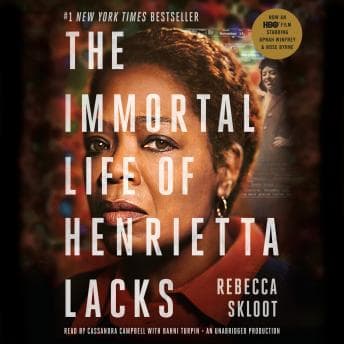
Then I picked up The Immortal Life of Henrietta Lacks.
Look, I thought I was getting a history lesson on cell biology. Something to make me sound smarter at dinner parties. Instead, I got a crash course in the worst kind of business deal: the one where the supplier gets absolutely nothing.
I listened to this on a flight to San Francisco—surrounded by VC pitch decks—and the irony wasn't lost on me. Here we have Henrietta Lacks, a poor Black tobacco farmer, whose cells (HeLa) literally launched a multi-billion dollar industry. Polio vaccines, cancer research, gene mapping. The ROI on her biology is incalculable.
And her family? They can't even afford health insurance.
Honestly, it made me want to throw my noise-canceling headphones out the window. (I didn't. Those are Bose. But the feeling was there.)
Two Narrators, One Devastating Story
Here's the thing about the audio version—it does something the print book can't. It splits the narrative duties between two narrators, and it's a brilliant move.
Cassandra Campbell handles the science and the historical context. She's got that smooth, NPR-style delivery. Very objective. Very "here are the facts." It's clean. Appeals to the part of my brain that likes spreadsheets and clear data.
But then Bahni Turpin steps in for the dialogue and the family's perspective.
If you've never heard Turpin narrate, you're missing out. She doesn't just read; she inhabits. When she voices Deborah Lacks (Henrietta's daughter), you hear the confusion, the anger, and the desperate need to know what happened to her mother. It's raw.
There's a scene where Deborah is terrified that scientists are coming to "clone" her mother, and Turpin's delivery is so visceral I actually had to drop my listening speed from my usual 2.0x to 1.25x.
(Yes, I slowed down. Don't tell my wife. She thinks I'm incapable of savoring the moment.)
This switching back and forth—between the cold, clinical world of Campbell's narration and the warm, painful reality of Turpin's performance—creates tension that keeps you hooked. It underscores the central conflict: the disconnect between medical progress and the human beings it grinds up in the gears.
The "Ethical ROI"
From a business perspective, this book is a nightmare scenario of stakeholder mismanagement.
Skloot (the author) does a solid job of not painting the scientists as cartoon villains—mostly. They were operating in a time when "informed consent" wasn't really a thing. But that doesn't make it easier to listen to.
The pacing drags a little in the middle—there's a lot of jumping around between decades that got murky while I was navigating airport security. A few times I had to hit the 30-second rewind button to figure out if we were in the 1950s or the 1980s.
But the payoff is worth it.
It forces you to ask: Who owns your biology? If I take a scraping of your cheek and cure cancer with it, do I owe you a cut of the profits? My parents ran a dry cleaning business for 30 years; they understood ownership. If you drop off a shirt, it's still your shirt. Apparently, in the 1950s at Johns Hopkins, if you dropped off some cells, they became public property. Communist Manifesto talks about labor exploitation in factories, but this is labor exploitation at the cellular level—and somehow even more personal.
The Bottom Line
This isn't a feel-good story about science saving the world. It's a messy, infuriating, necessary look at the cost of that salvation.
If you're in healthcare, biotech, or just business in general, you need to listen to this. It's a reminder that behind every "asset" on the balance sheet, there's usually a human being. Sometimes, a human being who never got paid.
Who should skip: If you want a straightforward science documentary or can't handle narrative time-jumps, this might frustrate you.
Jenny asked me how the book was when I got home. I told her it was "efficiently devastating." She nodded and handed me a glass of wine. She gets it.