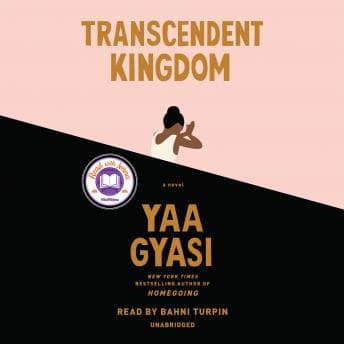

I was grading junior essays on The Great Gatsby at 11:47 PM - you know the ones, where they all claim Nick is "just like us" without a shred of textual evidence - when Bahni Turpin's voice cut through my exhaustion and stopped my red pen mid-stroke.
Gifty was explaining the neural circuits of addiction in mice. And I thought: here's a narrator who understands that science can be prayer.
When Faith and Dopamine Collide
Yaa Gyasi has done something I rarely see in contemporary fiction. She's written a novel about the oldest human question - why do we suffer? - and answered it with neither the comfort of religion nor the cold certainty of science. Gifty, our narrator, is a Stanford neuroscience PhD candidate studying reward-seeking behavior. She's also the daughter of Ghanaian immigrants, raised in an evangelical church in Alabama, watching her mother disappear into depression while her brother's ghost haunts every synapse she studies.
This is not a book that resolves tension. It holds it. Like Faulkner holding grief in his teeth.
The structure is non-linear - Gifty's present-day lab work intercut with childhood memories of her brother Nana's basketball games, her mother's hymns, the slow dissolution of a family that crossed an ocean for the American dream and found opioids instead. Some listeners found this challenging. I found it honest. Memory doesn't organize itself into neat chapters. It ambushes you while you're pipetting solutions into mouse brains.
Turpin Knows Silence Is Punctuation
Bahni Turpin's narration is the reason this audiobook works. Full stop.
She captures Gifty's voice with this precise, controlled quality - the voice of someone who has learned to intellectualize pain because feeling it might kill her. When Gifty discusses her research, Turpin's pacing is sharp, almost clinical. When she slips into memory - her mother singing in Twi, her brother's laugh before the injury that started everything - something softens. The Ghanaian accents for Gifty's parents feel authentic without becoming caricature. Her mother's broken English carries weight, history, sacrifice.
There's a moment where Gifty describes finding her brother after the overdose. Turpin doesn't perform grief. She lets the words do the work, her voice steady in a way that's somehow more devastating than tears would be. Gyasi's prose deserves to be savored, and Turpin knows it.
Some listeners mentioned needing time to adjust to her style. I didn't. But I've spent twenty years listening to teenagers read Hamlet like they're ordering a sandwich - I can appreciate a narrator who actually interprets the text.
The Weight of Quiet Stories
Here's what you need to know: this is not a plot-driven book. There's no twist. No redemption arc wrapped in a bow. Gifty's mother is in her bed, depressed. Gifty is trying to understand why. That's it. That's the engine.
My students would hate this. They'd ask "but what happens?" And I'd tell them: a woman tries to understand her own heart. That's what happens. That's everything.
Gyasi's debut, Homegoing, was epic - spanning centuries and continents. Transcendent Kingdom is the opposite. Intimate. Granular. Eight hours and forty-one minutes inside one woman's mind as she wrestles with questions that have no answers. Why did her brother die? Why did her mother stop living? Can faith and science coexist in the same body?
If you loved Marilynne Robinson's Gilead, this is its spiritual successor - though darker, angrier, less willing to offer comfort. Anna Karenina wrestles with similar questions about faith and suffering, though Tolstoy gives you a thousand pages to sit with the discomfort instead of eight hours.
Who Should Listen (And Who Should Walk Away)
This book is for readers who don't need resolution. Who understand that some grief doesn't heal - it just becomes part of you, like a scar or a prayer. It's for anyone who has watched addiction destroy someone they love and felt the rage of helplessness. Skip it if you want background audio or need your narratives to arrive somewhere tidy. The emotional intensity demands focus. I tried listening during a faculty meeting once - Principal Martinez was discussing budget allocations - and had to stop because I was tearing up at a description of a mouse pressing a lever for cocaine.
Not a good look.
Worth Pausing the Faculty Meeting For
Transcendent Kingdom asks whether we can hold two contradictory truths at once: that the brain is just chemistry, and that the soul might be real anyway. Gifty never answers this. Gyasi never answers this. The book ends - some said abruptly, I say honestly - with the question still open.
This reminds me of what Hemingway said about writing: "All you have to do is write one true sentence." Gyasi has written thousands of them. And Bahni Turpin speaks each one like she understands that pause is punctuation.
My mom will probably fall asleep during my podcast episode about this one. But I'm making it anyway.