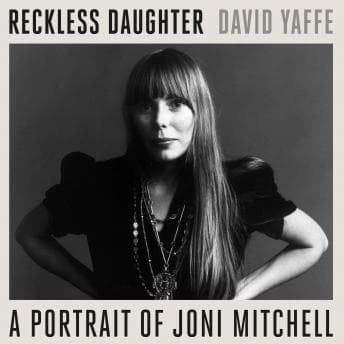

"I am a lonely painter, I live in a box of paints." Somewhere around hour three, Xe Sands reads that lyric and I'm sitting in my driveway at 7:45 AM, engine still running, trying to figure out why a line I've heard a hundred times just hit different. Carlos texted asking if I was okay. I told him I was having a moment with Joni Mitchell. He sent back a thumbs up. Fifteen years of marriage - the man knows when to just let it happen.
The Woman Behind the Canyon
Here's what I knew about Joni Mitchell before this book: "Big Yellow Taxi," "Both Sides Now," vague awareness she dated a lot of famous men, and that she had some kind of medical crisis a few years back. Here's what I know now: this woman had polio at nine years old, gave up a baby for adoption while still practically a kid herself, taught herself to play guitar in open tunings because polio weakened her left hand, and basically invented a genre of music that every singer-songwriter since has been trying to replicate. The polio detail stopped me cold. As someone who's actually worked with post-polio patients - the muscle weakness, the fatigue, the way it reshapes your entire relationship with your body - knowing she built those iconic guitar techniques around a disability rather than despite it? That's not inspiration porn. That's just straight-up remarkable engineering of a life.
Yaffe had real access here. Dozens of interviews with Mitchell herself, plus the supporting cast - Baez, Collins, Leonard Cohen, David Crosby. And you can feel the difference between a biographer working from clippings and one who's sat across from the subject. The section about the baby she gave up for adoption, the daughter she wouldn't reunite with for decades, has the kind of specific emotional texture you only get when someone actually told you how it felt. Not secondhand. Not speculative. Real.
That kind of emotional specificity from real access is rare - I noticed similar texture in Catch of the Day, also narrated by Sands.But - and this is a real but - Yaffe's music criticism sections can get dense. Like, academically dense. He's a music critic by trade and sometimes it shows. There were stretches where I needed the analysis to breathe a little, to let the story carry the weight instead of the theory. Around hours seven and eight, I caught myself drifting during some of the deeper dives into jazz influences and harmonic structure. And I say this as someone who regularly stays alert through twelve-hour overnight shifts. If I'm losing focus, the pacing needs work.
Xe Sands Talks Fast and Talks Close
The narration is genuinely intimate - Sands reads like she's sitting next to you, telling you about someone she knows. That conversational quality works beautifully for the personal sections. When she's narrating Mitchell's early days on the Canadian prairie or the chaos of Laurel Canyon, you're in it.
But she speaks quickly. I mean quickly. On my drive home - windows down because Phoenix in the morning is already trying to kill you - I lost whole sentences to road noise. Had to rewind three or four times in a single commute. I've had similar issues with Sands before - her pacing in Gideon had me reaching for the rewind button too. And there's this world-weary intonation she adopts, this kind of hip, knowing tone, that works about 70% of the time and grates the other 30%. During the sections about Mitchell's love affairs with various rock legends, the tone felt right. During the more analytical passages about lyrics and composition, it felt like someone trying too hard to be cool while explaining homework.
Volume consistency is also an issue. Some passages come through deep and quiet, others are perfectly clear. Not a dealbreaker on good headphones, but in a car? Frustrating.
Who Gets the Most Out of This
If you're already a Mitchell fan, this is going to fill in gaps you didn't even know existed. The backstories behind the albums - Blue, Court and Spark, Hejira - are genuinely revelatory. If you're coming in cold like me, you'll get a portrait of a complicated, brilliant, sometimes difficult woman who refused to be categorized by an industry that desperately wanted to put her in a box labeled "lady folk singer."
Skip it if you need constant narrative momentum. This is biography as deep study, not biography as thriller. And definitely don't try it as background listening - Sands' quick pacing demands your actual attention.
My mom would love this. Not for the music - she's a Celine Dion woman through and through - but for the story of a girl who refused to do what everyone expected and built something extraordinary out of sheer stubbornness. (She still thinks I should've been a doctor, but I think she's starting to see the parallel.)
Night Shift Prescription
Twelve hours and seventeen minutes is a real commitment, and the pacing doesn't always justify the length. But when this book is good - the adoption story, the polio, the way Yaffe traces how personal devastation became art - it's genuinely affecting. Carlos asked why I was crying in the car. I blamed allergies. It was 98 degrees and bone dry. He didn't push it.
Worth your time if you listen with intention. Just maybe not on the highway with the windows down.




![Steve Jobs [unabridged audiobook] audiobook cover](/_next/image?url=https%3A%2F%2Fcovers.audiobooks.com%2Fimages%2Fcovers%2Ffull%2F9788499923406.jpg&w=1920&q=75)