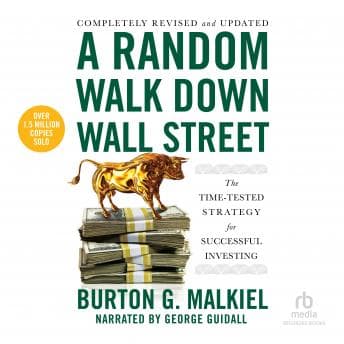

Look, I've been putting off this book for years. Every personal finance subreddit, every tech Twitter thread about FIRE, every coworker who discovered index funds—they all eventually mention A Random Walk Down Wall Street like it's scripture. So when I finally queued it up for my Monday morning commute, I expected to feel like I was back in my college econ lecture. And honestly? That's kind of what I got. But in a good way.
Here's the thing about Malkiel: he's basically the OG of "just buy index funds and chill." This book is the reason your 401(k) has a low-cost S&P 500 option. The man literally helped invent the strategy most of us should be using. So even though parts of this felt like reading documentation for a system I already use, understanding the why behind it was worth my 11 hours.
The Professor Energy Is Real
George Guidall narrates this, and I have complicated feelings. On paper, he's perfect—the guy has won basically every audiobook award that exists, and his voice has that authoritative, grandfatherly quality that makes you trust him with your retirement savings. But I'm gonna be honest: I nearly fell asleep twice during the first week. Not because the content is bad, but because Guidall reads this like he's teaching a 400-level finance seminar at 8 AM. Measured. Steady. Zero vocal fireworks.
Some listeners apparently love this—I saw reviews calling it "the best narration ever"—and I get it. For dense material, you want clarity over entertainment. But if you're someone who needs energy to stay engaged (hi, that's me at 6:15 AM surrounded by snoring strangers on Caltrain), you might need to bump the speed up. I went to 1.5x around chapter three and never looked back. At that pace, Guidall sounds almost conversational, and the content moves fast enough to keep your brain from wandering.
Where the Math Actually Matters
The core thesis is pretty simple: you can't consistently beat the market, so stop trying. Buy diversified index funds, keep costs low, stay the course. If you've spent any time in r/personalfinance or r/Bogleheads, this isn't news. But Malkiel doesn't just tell you what to do—he shows you decades of data on why active fund managers fail, why technical analysis is basically astrology for finance bros, and why your coworker's hot stock tip is statistically worthless.
The sections on behavioral finance were genuinely fascinating. Malkiel breaks down all the cognitive biases that make us terrible investors—overconfidence, loss aversion, the tendency to chase past performance. As someone who debugs distributed systems for a living, I appreciated the systematic approach. It's like he's documenting all the edge cases in human decision-making and showing you how to build guardrails against your own stupidity.
The life-cycle investing guide at the end is actually super practical. He gives specific asset allocation recommendations based on your age and risk tolerance, with actual percentages. This is the stuff that could've been a blog post, except Malkiel backs it up with enough historical data that you actually believe him.
The 2018 Problem
Here's my main gripe: this edition is from 2018, and it shows. There's a chapter on bitcoin where Malkiel is pretty dismissive, calling it a bubble—which, okay, fair enough, but a lot has happened since then. The sections on robo-advisors feel dated too. For a book that gets updated every few years, I wish the audiobook version was more current. If you're looking for takes on 2023 market weirdness or the latest on factor investing research, you'll need to supplement this with newer content.
The core principles haven't changed, though. The efficient market hypothesis doesn't care what year it is. And honestly, the historical examples—from the tulip mania to the dot-com crash—are timeless cautionary tales. Malkiel has this slightly cheeky way of describing financial manias that kept me entertained even when the material got dense.
The ROI Calculation
So is this worth 11+ hours of your life? If you're already a Boglehead who maxes out your 401(k) and holds VTI until death, you probably don't need this. You already know the punchline. But if you're earlier in your investing journey, or if you've been doing the right things without really understanding why, this is foundational. It's the textbook for the strategy most of us should be following.
I finished this over about two weeks of commutes, and by the end, I felt weirdly calm about my portfolio. That same sense of calm—finding power in not forcing things—is what Stillness is the Key is all about. Not because Malkiel promised me riches, but because he made a convincing case that staying boring and consistent is the optimal strategy. For a book about randomness, that's pretty reassuring.
Perfect for: long commutes, gym sessions where you want to feel productive, anyone who needs to understand why their financial advisor is probably not worth the fees. Skip if: you need high-energy narration to stay awake, or you're already deep in the index fund cult and don't need the sermon.