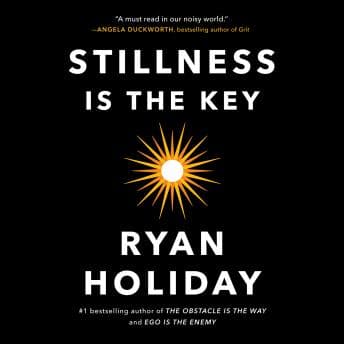

Look, I'll be honest - I started this audiobook during a particularly chaotic week. Three grant proposals due, my upstairs neighbor decided to learn drums, and my email inbox had reached a level of unread messages that my therapist would definitely have thoughts about. So when Ryan Holiday opened by talking about stillness as the secret weapon of great leaders, I laughed out loud. Literally. On the treadmill. People stared.
But here's the thing. By chapter three, I'd stopped laughing and started taking notes.
The Psychology Behind the Philosophy
What Holiday does here - and this is where my professional interest kicked in - is essentially translate ancient wisdom into cognitive behavioral principles without ever using the clinical language. The research actually shows that what he's describing as "stillness" maps almost perfectly onto what we call emotional regulation and attentional control in the literature. He just makes it sound less like a journal article and more like something you'd actually want to practice.
The structure is clever. Mind, spirit, body - three sections that build on each other. It's not groundbreaking from a psychological standpoint (we've been studying the mind-body connection for decades), but Holiday's gift is accessibility. He takes Seneca and Marcus Aurelius and makes them feel like mentors rather than dusty philosophers you had to read in undergrad.
The examples are where this book shines. Sadaharu Oh studying Zen to become the greatest home run hitter ever? That's a fascinating case study in how contemplative practice enhances performance under pressure. Winston Churchill laying bricks at Chartwell while saving the world from fascism? Perfect illustration of how cognitive rest through physical activity actually works. Fred Rogers - and okay, I got a little emotional during this section - as a model of presence and attention. Holiday understands human nature, and he uses these stories to prove that stillness isn't weakness. It's strategy.
When the Author Becomes the Narrator
Here's where things get interesting. Holiday narrates his own book, which is always a gamble. Some authors sound like they're reading a grocery list. Others sound like they're performing Shakespeare at you. Holiday lands somewhere in between - measured, calm, almost meditative. Which makes sense, right? A book about stillness shouldn't be narrated like a true crime podcast.
But I have to be real: the narration is polarizing. I found his pacing deliberate in a way that matched the content. Like he was actually practicing what he preached. But I can see how some listeners would find it monotone. There were moments - especially in the middle section - where I caught my attention drifting. Not because the content was weak, but because the delivery was so even that my brain started treating it as background noise.
The choppy speech patterns some reviewers mention? I noticed them. It's like Holiday is reading in thought-chunks rather than flowing sentences. Psychologically, this might actually be intentional - forcing you to process each idea separately. But if you're used to more dynamic narrators, it could feel jarring.
Who Should Listen (And Who Should Skip)
Let me put on my behavioral psychologist hat for a second. This book is essentially a gateway drug for people who've never considered meditation or mindfulness but are skeptical of anything that sounds too "woo-woo." Holiday wraps contemplative practice in historical examples and Stoic philosophy, making it palatable for the type-A overachiever who thinks yoga is for people who can't handle real exercise. That same practical, no-nonsense approach to behavior change is what makes Atomic Habits so effective—James Clear strips away the mysticism and gives you the mechanics. (Don't @ me. I was that person.)
If you're already deep into mindfulness practice, you might find this surface-level. Holiday isn't breaking new ground - he's synthesizing existing wisdom for a new audience. Skip this if you've already read the Stoics and have an established meditation practice; you won't find much new here. But if you need someone to curate the ancient wisdom without the academic jargon? This is your entry point.
The American cultural references thing some reviewers mentioned - I get it. There's definitely a Western, particularly American, lens here. But Holiday draws from Eastern philosophy throughout, so it's not as limited as some suggest.
Case Notes
I finished this during a 6 AM jog through Cambridge, and I'll admit - I felt calmer walking back to my apartment than I had in weeks. Placebo effect? Maybe. But the principles Holiday outlines are grounded in real psychological research, even if he never cites a single study. The protagonist of this book - and yes, I'm treating it like a case study, because that's what I do - is you, the overwhelmed modern human. And Holiday's prescription is simple: slow down to speed up.
Would I recommend the audiobook specifically? Sample first. Seriously. The narration works for some people and actively doesn't for others. If Holiday's calm, measured voice feels like a warm blanket, you'll love it. If it feels like someone reading you a very long bedtime story when you're not tired, maybe grab the print version instead.
For me, it worked. My therapist would probably say that's because I needed permission to stop. Holiday gave me that permission wrapped in historical examples and Stoic philosophy. And honestly? I'll take it.