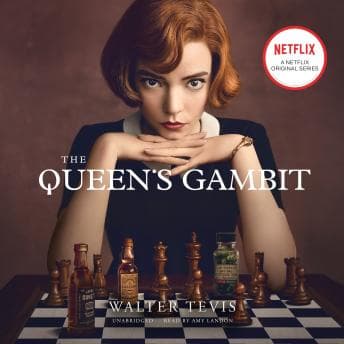

What happens when a narrator sounds like she might actually be the chess prodigy she's voicing - cold, calculating, and slightly detached from the messy emotions swirling around her?
I've been meaning to get to this one forever. Watched the Netflix series during a particularly brutal stretch of night shifts last year - you know, the kind where you're so tired you can't sleep when you get home, so you just... watch things. Beth Harmon's story hit different at 4 AM when you're running on caffeine and spite. So when I finally downloaded the audiobook, I had expectations. Maybe too many.
The Voice That Divides
Okay, let's talk about Amy Landon. Because everyone has opinions. Strong ones.
Some folks are calling her narration robotic. AI-like. One reviewer literally compared her to Siri. And look - I get it. There's a flatness there, an emotional distance that can feel jarring if you're expecting warmth. But here's the thing: have you MET Beth Harmon? This is a kid who grew up in an orphanage, got hooked on tranquilizers before she hit double digits, and processes the world through chess patterns instead of feelings. That same kind of emotional detachment - a character shaped by institutional trauma - shows up in Little Men, though the setting couldn't be more different.
Landon's aloofness? It works. For me, anyway. That calculated delivery mirrors how Beth moves through life - observing, analyzing, keeping everyone at arm's length. It's not cozy. It's not going to make you feel all warm and fuzzy. But it's authentic to the character in a way that a more emotional read might not be.
That said. I did bump the speed to 1.25x about two hours in. The pacing needed it. Night shift Maria does not have patience for slow when she's trying to decompress before the sun comes up.
When the Story Does the Heavy Lifting
Walter Tevis wrote this in 1983, and honestly? It holds up scary well. The addiction threads - both to the pills and to chess itself - feel uncomfortably real. As someone who's watched patients fight demons that started with legitimate prescriptions, Beth's spiral hit close to home. The way she uses the pills to visualize chess games on the ceiling, then can't play without them... that's not melodrama. That's just how dependency works.
The chess itself could've been boring. Should've been boring, maybe, for someone who doesn't know a rook from a bishop (me, I'm someone). But Tevis keeps the focus on what the game means to Beth - control, identity, escape - rather than getting lost in technical moves. Smart. The tension builds through Beth's isolation, her hunger for something she can actually master in a world that's failed her in every other way.
I found myself gripping my steering wheel during the tournament scenes. Carlos asked why I looked so stressed when I walked in the door. "Chess," I said. He gave me a look. Fair.
The Netflix Comparison Nobody Asked For
If you loved the show and you're expecting that exact experience - pump the brakes. The book is quieter. More internal. Less visually stunning, obviously (it's an audiobook, Maria, come on). But there's something about hearing Beth's thought process that the show couldn't quite capture. The way she calculates, the way she notices details about opponents that have nothing to do with chess.
Some listeners DNF'd because they found the series more engaging. I get that. The show had Anya Taylor-Joy's face and that incredible cinematography. But the book has Beth's actual brain, and that's worth something.
Who Should Listen (And Who Should Skip)
This is perfect for: coming-of-age story lovers, anyone fascinated by addiction and obsession, people who can handle a narrator that matches character energy over audience comfort. Night shift approved - it's engaging enough to keep you alert but not so action-packed that you miss chunks when you're charting.
Maybe skip if: you need emotional warmth from your narrators, you're expecting the Netflix vibe exactly, or flat pacing drives you up a wall even at 1.25x.
The production is clean. No weird audio issues, no background noise. Professional all the way.
Would I Listen Again?
Probably not - but that's not a criticism. It's a one-and-done story for me, the kind you experience fully and then carry with you. Beth Harmon's loneliness, her brilliance, her terrible coping mechanisms... they stick. Landon's cool delivery actually made it easier to absorb, weirdly. Less emotionally exhausting than if someone had been sobbing through the addiction scenes.
The book is fantastic. The narration is a choice. For me, it worked. Your mileage may vary - and that's okay. Just maybe try a sample first.