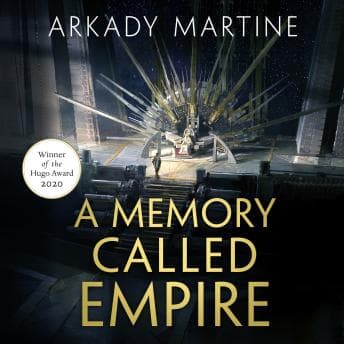

What happens when the legacy system running inside your brain starts throwing unhandled exceptions?
That's basically the premise of A Memory Called Empire, and as someone who debugs distributed systems for a living, this metaphor hit uncomfortably close to home. Mahit Dzmare carries an imago — a neural implant containing her dead predecessor's personality and memories — and when it malfunctions, she's stranded in the most dangerous political environment imaginable with half a dead man's context and none of his connections.
I started this one on a Saturday morning, thinking I'd knock out a few hours while meal-prepping. Twelve hours later, Kevin found me sitting on the kitchen floor with headphones still in, the rice cooker long since done, completely absorbed in Teixcalaanli court politics. He just sighed and brought me water. He's been through this before.
When Your Space Opera Is Actually a Byzantine History Dissertation (Complimentary)
Arkady Martine is literally a Byzantine Empire historian, and oh, it shows. This isn't pew-pew space battles — it's a political thriller wearing sci-fi clothes. The Teixcalaanli Empire runs on poetry and bureaucracy, and the power plays happen through verse competitions and committee maneuvering, not laser fire. Every character name is a number-noun combination — Three Seagrass, Nineteen Adze, One Lightning — which sounds gimmicky for about ten minutes until you realize it creates this immediate wall of alienness. You're constantly reminded that Mahit is the outsider, the one with the "normal" name in a world where hers is the weird one.
But here's what got me. The cultural seduction angle. Mahit grew up obsessed with Teixcalaanli literature. She WANTS to belong to this empire that is actively trying to swallow her tiny space station whole. It's like — okay, imagine discovering the system that's about to deprecate your entire service is just... beautifully architected. That tension between admiration and self-preservation runs through every interaction, and Martine never takes the easy route by making the empire cartoonishly evil. Teixcalaan is gorgeous and cruel and functional, and you understand exactly why Mahit keeps getting pulled deeper even when you want to shake her.
Amy Landon vs. The Pronunciation Boss Fight
Here's the thing about this book on audio: those naming conventions could've been an absolute disaster. Amy Landon handles the Teixcalaanli names with this consistent, deliberate clarity that means you never lose track of who's who, even when the political factions start multiplying. She gives Mahit a slightly detached, analytical quality — all diplomat control — that cracks open during the moments of real emotional impact, and it works because Mahit IS that person. She's running political calculations while processing grief.
Landon's delivery is calm and measured. Perfect fit for the material. I've heard that same steady hand in White Fragility, where Landon's clarity makes a tough conversation feel navigable. But — and this is the commute-worthiness catch — it means the pacing sits firmly in contemplative territory. I lost the thread twice during dense political dialogue at my usual 1.5x. Dropped to 1.25x and everything clicked. The book rewards your full attention in a way that makes it a genuinely rough 6AM listen. I tried. The Teixcalaanli court does not care that you're half-asleep between Millbrae and San Mateo.
The Imago Problem (a.k.a. Pair Programming With a Dead Coworker)
The imago technology is the real hook, and it's where Martine gets genuinely inventive. Imagine pair programming with someone whose instance is corrupted. Mahit has fragments of Yskander's memories surfacing at wrong moments, personality bleed she can't predict, and this constant low-grade terror about where she ends and he begins. When the imago fails completely — and I won't spoil exactly when — the silence is devastating. Landon plays that absence with this sudden hollowness in Mahit's internal monologue. You feel the gap like a dropped connection.
The murder mystery plot is... fine? Functional. But it's honestly not the point. The point is watching Mahit navigate an empire that considers her barely civilized while she carries technology that would terrify them. The political layers stack like microservices — each makes sense individually, but the emergent complexity of their interactions kept surprising me eight, ten, twelve hours in.
Who Gets to Deploy This
Perfect for: dedicated weekend listening, road trips, alert commute hours. If you loved Ancillary Justice's language-as-worldbuilding or The Goblin Emperor's deadly-court-fish-out-of-water vibe, this is absolutely your book.
I got that same dangerous court intrigue from Three Dark Crowns, and Landon's narration there is equally sharp.Skip for: 6AM zombie mode. Background listening. Anyone who needs action beats every twenty minutes to stay locked in. The pacing is deliberate and completely unapologetic about it.
Commit to Main?
TL;DR: Worth your commute — but only your alert commute. At 15+ hours, it demands serious investment and actual attention, but the worldbuilding payoff is substantial. The imago concept alone justifies the listen, and Martine writes empire and identity with the authority of someone who's studied both academically. Amy Landon delivers a controlled, clear performance that serves the material well, even if she won't give you the dramatic voltage of a Ray Porter. (Nobody does. That's fine.)
I finished this across one very intense weekend and immediately bought the sequel. I'm still thinking about Three Seagrass's loyalty architecture three days later. The ROI on this audiobook is high — you just have to actually pay attention to collect it.