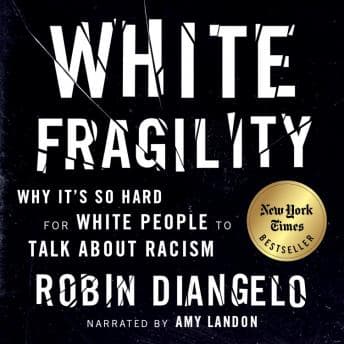

Look, I usually use my 6 AM Caltrain commute to escape into space operas or optimize my investment portfolio. I want aliens or alpha, not an existential crisis before I've had my second coffee. But my team leads have been pushing for more "soft skills" development (tech speak for "please stop acting like robots"), and this title kept popping up in the Slack channels.
So, I bit the bullet. I paused my sci-fi epic, queued up White Fragility, and honestly? It felt like debugging legacy code—the kind you wrote three years ago, thought was perfect, and now realize is riddled with critical vulnerabilities.
The "NPR Voice" Feature (Not a Bug)
Let's talk about the audio interface first. Amy Landon narrates this, and I've seen some reviews online complaining that she sounds "robotic" or "too NPR." I get that critique, but I disagree.
Here's the thing: DiAngelo's content is heavy. Emotionally charged. It triggers that specific "fight or flight" response in your brain (the amygdala hijack, for the optimization nerds out there). If the narrator had been emoting all over the place, shouting or whispering dramatically, I would've turned it off. Too much signal, too much noise.
Landon's delivery is measured. Calm. Almost clinical. And that works—it acts like a heat sink for the friction the text creates. She delivers hard truths (like how "niceness" isn't the same as anti-racism) with the steady cadence of a system administrator explaining why the server crashed. It allowed me to actually process the data without getting defensive at the tone.
(Fair warning: at 1.0x speed, it might put you to sleep. I cranked this to 1.75x and her diction held up perfectly. High clarity, zero packet loss.)
Debugging the Internal OS
The core argument hit me harder than I expected. DiAngelo frames racism not just as "bad people doing bad things" (malicious actors), but as a systemic, structural issue that we're all running in the background.
As someone who builds distributed systems, this metaphor clicked instantly. We have these default settings—defensiveness, silence, argumentation—that trigger automatically when our racial worldview is challenged. DiAngelo calls it "fragility." I call it a fatal exception error.
The book is basically a documentation manual for these errors. It explains why we freeze up or get angry when race comes up. It's uncomfortable. Seriously. There were moments on the train where I felt physically squirmy, recognizing my own past behaviors in her examples. (The chapter on "white women's tears"? Oof. Direct call-out.)
But like any good post-mortem, you can't fix the outage if you don't admit the system is broken. That kind of honest self-assessment is what I appreciated about Stillness is the Key too—different topic, same willingness to sit with discomfort instead of optimizing it away.
The ROI on Your Time
It's short—just over 6 hours. That's barely three days of commuting for me.
Could this have been a blog post? Maybe. Some parts feel repetitive, looping over the same logic to make sure it lands. But given how resistant the human brain is to this specific topic, the redundancy is probably a necessary feature, not a bug.
This isn't a "fun" listen. You won't get that dopamine hit of finishing a thriller. But it's a necessary patch update for your worldview. Who should queue this up: anyone in tech, education, or literally anywhere with other humans—especially if conversations about race make you want to immediately defend yourself. Who should skip: if you're looking for entertainment or already deep in anti-racism work, this 101-level framework might feel too basic.
Just... maybe don't listen to it right before bed. It keeps the CPU spinning.