
Can we talk about how Ren Owens has the audacity — the absolute audacity — to make a life-altering decision for the woman he supposedly loves without consulting her? I was unloading the dishwasher when that particular revelation hit, and I literally stopped with a mug in each hand and said "oh no you didn't" out loud to my empty kitchen. Because look. I get it. He's an elite Order member. He's protective. He thinks he's saving her. But the fallout from that choice is so messy and raw that I spent the next two hours of this audiobook toggling between wanting to hug him and wanting to throw my phone into a lake.
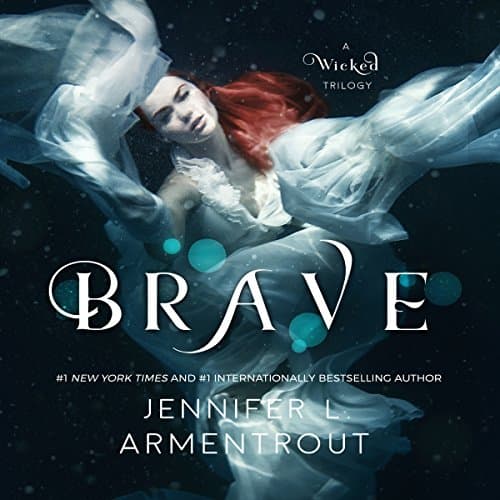
That right there is the emotional engine of Brave, the third and final book in Jennifer L. Armentrout's Wicked Trilogy. And honestly, for a series finale in paranormal romance, it's doing a lot more heavy lifting than it has to. Ivy Morgan starts this book broken in a way that feels uncomfortably real — she's been held captive by a fae prince, she's got something dark spreading through her that's more than just PTSD metaphor, and the person she trusts most just betrayed her trust in a way she can't easily forgive. That tension between Ivy and Ren isn't just romantic drama for drama's sake. It costs something. You feel the distance between them even when they're in the same room.
The conspiracy layers are where Armentrout really shows up. Everything Ivy and Ren believed about the Order — their allies, their mission, the nature of their enemies — gets systematically dismantled across eleven hours. There's a specific stretch in the middle act where revelations stack on top of each other fast enough that I had to rewind twice because my brain was still processing the previous bombshell. The worldbuilding around the fae and the Otherworld deepens considerably here, and some of the twists genuinely reconfigure how you understand the entire trilogy. That same sensation of having the rug pulled — realizing the map you've been reading is completely wrong — is something fans of A Court of Thorns and Roses or A Shadow in the Ember will recognize immediately.
I spent a lot of time with that same vertigo in A Shadow in the Ember, which Armentrout builds with the same architectural patience — and which wrecked me in a completely different direction.One thing I genuinely love about Ivy as a narrator-protagonist: she's funny even when she's falling apart. Her internal monologue has this dry, self-aware bite that keeps the darker material from suffocating you. There's a war literally brewing, fae are terrifying (not the cute kind — the kind that make your skin crawl), and Ivy's cracking jokes about her own catastrophic life choices. It works because it feels like how an actual person copes, not because the author forgot the tone.
Now. Amy Landon. This is the part where I have to be honest, because the listening experience here is genuinely split.
Landon has real clarity. During the emotional confrontations — especially when Ivy is processing Ren's betrayal — her measured, steady delivery gives those scenes room to land. That same restraint is what kept me sane through Queen's Gambit, where Landon's evenness is actually the right call for a story that could easily tip into melodrama. She doesn't oversell the pain, which actually makes it hit harder. When there are multiple characters in a scene, you stay oriented. She's professional and consistent.
But there's a flatness. It's not constant, and I wouldn't call it monotone exactly, but during exposition-heavy stretches and quieter dialogue, the energy dips in a way that made me zone out more than once. I was folding laundry during one of those stretches and realized I'd missed about five minutes without noticing. If you're the kind of listener who needs vocal dynamism to stay locked in — especially during a commute or while multitasking — this could be a problem. At 1.25x speed, a lot of that flatness tightens up and the pacing feels noticeably more natural. I'd recommend trying it.
The eleven-hour runtime is well-structured: emotional aftermath in the first third, conspiracy and war-building in the middle, and a final act that delivers real action payoffs. Nothing drags. For what it needs to accomplish as a series closer, the pacing is right.
Content warning territory: this is adult paranormal romance with teeth. The violence gets graphic, the sexual content goes well beyond fade-to-black, and the horror elements are genuine. The fae in this world are dangerous and often terrifying, and Armentrout doesn't soften that.
Here's the thing about Brave as a finale: it earns its ending. Ivy's arc doesn't wrap up because the trauma magically disappears. She fights through it — through betrayal, through the darkness literally consuming her, through having to ally with an enemy she'd rather kill. That final resolution feels honest rather than convenient, which is rarer than it should be in this genre. If you've spent two books investing in Ivy and Ren, this book pays that off. If you haven't read Wicked and Torn first, don't start here — you need that foundation to feel the full weight of what happens.
The narration isn't flawless, but the story underneath is strong enough to carry it. This is a series closer that actually closes things, and for eleven hours of your time, that's worth something.