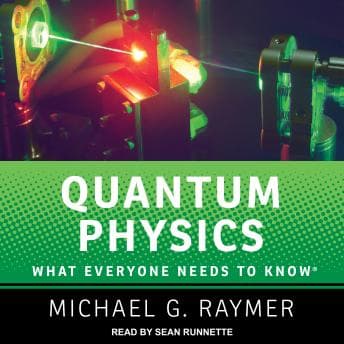

Everyone told me this would be the quantum physics book that finally clicks. The one that bridges the gap between "I vaguely remember Schrödinger's cat" and actually understanding why my company's security team keeps talking about quantum encryption like it's the apocalypse. And look—Raymer delivers on that promise. Mostly.
But here's the thing nobody warned me about: this is not a casual listen.
The 6 AM Reality Check
I started this on a Monday morning commute, 1.5x speed like usual, half a cold brew in. By Sunnyvale I realized I'd retained approximately nothing from the last twenty minutes. Quantum superposition was happening in my brain—I was simultaneously listening and not listening.
So I did something I almost never do: slowed it down to 1x. And restarted.
Raymer structures this as a Q&A format—"What is wave-particle duality?" "Why does quantum entanglement matter for computing?"—which sounds like it should be perfect for audio. And it is, when you're actually paying attention. The problem is that unlike, say, a business book where you can zone out for ten minutes and still catch the thesis (because they repeat it seventeen times), here each concept builds on the last. Miss the explanation of quantum states and you're lost when he gets to qubits.
This is basically a graduate seminar for your ears.
Sean Runnette's Secret Weapon: Patience
I've heard Runnette on thrillers before, where he's all tension and pacing. Here he does something smarter—he slows way down on the math-adjacent sections without making it feel condescending. There's this measured quality to his delivery that gives your brain time to actually process "the electron doesn't have a definite position until measured" before he moves to the implications.
No accent work needed (obviously), no character voices. Just clear, professional narration that doesn't get in the way of dense material. Which is exactly what you want. He's not trying to make quantum physics entertaining—he's trying to make it comprehensible. Different job, and he nails it.
Where My Ears Actually Perked Up
The sections on quantum computing and cryptography? This is where it got real for me. Raymer explains why governments are dumping billions into quantum research without resorting to sci-fi hand-waving. The breakdown of how quantum key distribution works—and why it matters that China launched a quantum satellite—felt genuinely urgent. Like, oh, this is why my VP keeps bringing this up in all-hands. Accessory to War covers similar ground on how cutting-edge physics becomes military strategy, though Tyson focuses more on the institutional relationships than the tech itself.
The historical context is solid too. He traces the intellectual lineage from Planck to Bohr to Heisenberg in a way that makes the uncertainty principle feel like a logical discovery rather than some weird philosophical gotcha. That progression from confusion to clarity reminded me of how Kybalion builds its hermetic principles—both books are trying to make fundamentally weird concepts feel inevitable once you see the logic. You understand why these physicists were confused, which makes the solutions more satisfying.
But—and this is a real but—some sections feel like they could've been condensed. There's a stretch in the middle covering quantum optics that, while technically interesting, had me checking how many hours remained. Nine hours is a lot for a "What Everyone Needs to Know" book. Some of this material is definitely not what everyone needs to know.
The ROI Calculation
Perfect for: focused commutes (no packed trains), weekend deep work, anyone who needs to actually understand quantum computing for their job and not just nod along in meetings.
Skip if: you want background listening, gym sessions, or anything where you might get distracted. This book will punish you for multitasking.
I finished this across maybe eight commutes—but only because I had to replay sections. If you're coming in with a STEM background, you'll move faster. If your last physics class was high school, budget more time.
The ROI on this audiobook is high if you actually need this knowledge. It's genuinely useful, not just interesting. But it requires commitment. This isn't a book that washes over you—it's a book you have to actively wrestle with.
Worth the Brain Cycles?
Here's my honest take: I'm glad I listened to this. I can now follow quantum computing discussions without faking it, and I have a much clearer mental model of why quantum mechanics is weird in specific ways rather than just generically "spooky."
But I wouldn't recommend this to someone looking for a fun science listen. This is homework. Good homework—well-structured, clearly explained, professionally narrated homework. But homework nonetheless.
If you're in tech and quantum keeps coming up in your periphery, this is the audiobook that'll get you fluent. Just don't start it at 6 AM on four hours of sleep. Trust me on that one.



![Steve Jobs [unabridged audiobook] audiobook cover](/_next/image?url=https%3A%2F%2Fcovers.audiobooks.com%2Fimages%2Fcovers%2Ffull%2F9788499923406.jpg&w=1920&q=75)