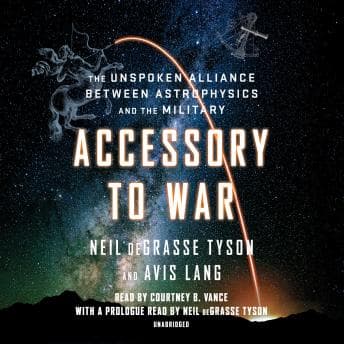

Look, I wasn't expecting to spend almost 19 hours thinking about how my GPS is basically a military hand-me-down. But here we are.
Neil deGrasse Tyson and Avis Lang have written what is essentially a massive historical deep-dive into how astrophysicists and the military have been in a codependent relationship since... well, since humans started looking up and realized the stars could help them kill each other more efficiently. That's the thesis. And they spend 18+ hours proving it.
The Uncomfortable Truth About Your Telescope
Here's the thing about this book - it's not what you'd expect from Tyson. If you're coming in hot from Astrophysics for People in a Hurry, pump the brakes. This is Astrophysics for People With a LOT of Time and a High Tolerance for Historical Context. The book traces everything from ancient celestial navigation (turns out knowing where the stars are helps you sail your warships in the right direction, who knew) all the way to modern satellite warfare and GPS-guided missiles.
The core argument is pretty straightforward: the same tech that lets us study black holes also lets militaries track targets from orbit. Multi-spectral imaging, tracking systems, nuclear fusion research - scientists and soldiers want access to the same toys. And historically, the military has had way deeper pockets. So astrophysicists have made some... let's call them pragmatic alliances.
I finished this over about two weeks of commutes, and I'll be honest - some sections had me completely locked in, and others had me zoning out somewhere around Hillsdale station. The historical stuff is genuinely fascinating when it clicks. Learning about how astronomers in WWII basically became military intelligence assets? Wild. Understanding why NASA and the Department of Defense have such a complicated relationship? Actually super relevant to understanding modern space policy.
But then there are stretches where it feels like you're listening to a really thorough Wikipedia article. Dense. Detailed. Occasionally dry.
Courtney B. Vance Carries the Weight
Okay, so Courtney B. Vance narrating this was a smart choice. His voice has that warm, authoritative quality - people compare him to Morgan Freeman and honestly, I get it. He makes the dense historical passages more digestible than they probably deserve to be. When the material gets into the weeds of 16th-century navigation instruments, Vance's delivery keeps you from completely checking out.
That said, there are sections where the pacing feels rushed. Like someone told him they needed to keep this under 19 hours and he had to pick up speed in places. It's not a dealbreaker, but I noticed it during some of the more technical explanations where I would've appreciated a slower cadence.
The production quality is clean - no weird background noise or audio issues. Professional all the way through.
The ROI Calculation
So here's my honest take on whether this is worth your commute hours:
The ROI on this audiobook is... complicated. If you're into science history, space policy, or you've ever wondered why so much astronomical research gets military funding, this is genuinely valuable. I learned things I didn't know I wanted to know. The section on how the same satellites that give us weather data also provide military surveillance? Legitimately made me think differently about dual-use technology.
But - and this is a big but - at 18 hours and 39 minutes, it's a commitment. And not all of those hours are created equal. Some chapters are riveting. Others feel like they could've been condensed. I had a similar reaction to Relativity: The Special and General Theory - brilliant ideas buried under pacing that doesn't always respect your time. The "could've been a blog post" criticism doesn't quite apply here (there's too much substance), but "could've been a 12-hour audiobook" might.
Who Should Listen (And Who Should Skip)
Perfect for: long commutes, road trips, anyone who liked The Pentagon's Brain or similar military-industrial complex histories. Also great if you're a space nerd who wants to understand the less romantic side of how we got to the stars.
Skip if: you need fast pacing, want pure science without the historical and political context, or you're looking for Tyson's usual accessible pop-science style. This is not that.
I listened at 1.5x and it worked fine - Vance's delivery is clear enough to handle the speed bump without losing comprehension. Might even recommend 1.25x if you really want to absorb the denser sections.
Would I listen again? Probably not the whole thing. But I'd definitely revisit specific chapters - the modern space warfare stuff, the sections on GPS development. Those are genuinely worth coming back to.
It's a heavy book with a heavy thesis: science and war have always been dance partners, and that's not changing anytime soon. Tyson and Lang don't really offer solutions, just a very thorough history lesson. Make of that what you will.






![Steve Jobs [unabridged audiobook] audiobook cover](/_next/image?url=https%3A%2F%2Fcovers.audiobooks.com%2Fimages%2Fcovers%2Ffull%2F9788499923406.jpg&w=1920&q=75)