
I have a bone to pick with the audiobook industry.
I'm standing in my kitchen at midnight, covered in flour—don't ask, the sourdough starter was a gift and now it's a burden—listening to Susan Ericksen navigate a wedding shower scene. And I'm annoyed. Not at her. I'm annoyed because she makes it look so easy that it exposes how lazy other narrators are.
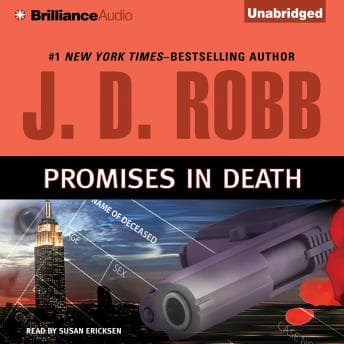
Usually, when an author writes a scene with five or more distinct female characters in one room, the audio version turns into a screeching contest. The voices bleed together until you can't tell the bride from the detective. But here? In *Promises in Death*? Ericksen is juggling personalities like chainsaws.
The Ensemble Test (She Passes)
There's a specific sequence—a wedding shower—that should be a disaster on audio. You've got the pragmatic Eve Dallas, the bubbly Mavis, the straight-laced Peabody, and a room full of others. Ericksen doesn't just do "accents." She does cadence. She does attitude. You can practically hear Mavis bouncing on the balls of her feet while Eve stands there awkwardly trying to escape the estrogen overdose.
If you listen to as much horror and thriller audio as I do, you know how rare this is. Most narrators have a "protagonist voice" and a "side character voice." Ericksen has a rolodex. By the time the scene ended, I'd forgotten it was one woman talking to herself in a recording booth. Shirley (my cat, currently watching me struggle with this dough from atop the fridge) seemed equally captivated. Or maybe she just likes the sound of murder investigations. Hard to tell with her.
Grief Over Gore
Look, I'm the guy who tells you to read *The Haunting of Hill House* for the psychological damage. I don't usually go for police procedurals where the good guys have super-science on their side. But this one hits different because of Morris. That same emotional weight—where the horror isn't supernatural but deeply human—shows up in Girl Before: A Novel, though it trades the badge for psychological manipulation.
The victim, Amaryllis Coltraine, isn't just a body drop to start the clock. She's Morris's partner. And because we know Morris—because we've spent books with him—the grief is heavy. It's not the creeping dread I usually hunt for; it's a sharp, emotional gut-punch.
When Eve gets the box containing Coltraine's guns and badge? The way Ericksen drops her register, shifting from the chaos of the investigation to the cold, hard promise of retribution? That is acting. That's the "magic" I talk about on the podcast. It's not scary in the "monster under the bed" way. It's scary because you believe Eve Dallas is going to tear the city apart, and you're just glad you're not in her way.
Who's This For (And Who Should Run)
If you're jumping in here without listening to the previous 27 books, you're a chaotic individual and I respect that, but you might be lost on the character dynamics. Skip this one if you need your crime fiction gritty and grounded—the futuristic tech and established universe will throw you. For the rest of us who've been riding with Eve and Roarke? This is Ericksen flexing her muscles. She takes a plot that could have been a standard "cop killer" procedural and elevates it into a character study on loss.
Worth a Burnt Loaf
Is it high literature? No. It's J.D. Robb. It's comfort food with a side of autopsy reports. But in terms of audio craft, this is the gold standard.
I listened to the last hour sitting on my kitchen floor, the bread burning in the oven, because I couldn't pause the confrontation. Worth the smoke alarm? Yeah. Probably.