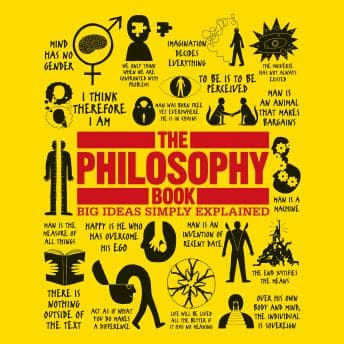

Can you actually learn philosophy without reading philosophy? That's the question I kept circling back to while stirring a lamb rogan josh that demanded way more attention than I was giving it - because I was sixteen hours deep in a DK explainer and genuinely unsure whether I'd just gotten smarter or just gotten more confident about name-dropping at dinner parties.
Here's the thing. I came to this as someone who took exactly one philosophy course in undergrad before pivoting hard into psychology, and I've spent the last decade treating philosophical questions as the backstory to the behavioral science I actually care about. So when DK's Philosophy Book walks you through over 100 thinkers from Thales to Kristeva, I found myself asking: why does this book exist in audio form, and does it actually work without the visual layout DK is famous for?
100 Thinkers in 16 Hours Is Either Ambitious or Reckless
Let's do the math. Sixteen hours, a hundred-plus philosophers. That's roughly eight to ten minutes per thinker, which means you're getting the Wikipedia-plus version of everyone from Confucius to Simone de Beauvoir. The structure is chronological-ish, grouped by era and movement, and it moves with the brisk efficiency of a professor who has fifteen minutes left and twelve slides to go.
Some thinkers get genuinely useful treatment. The section on Descartes doesn't just give you "I think, therefore I am" and call it a day - it actually contextualizes the Meditations within the broader rationalist project, which I appreciated. Mary Wollstonecraft's segment connects her ideas to the political moment she was writing in, not just the feminist canon she ended up in. These are the moments where the book earns its "Simply Explained" subtitle honestly.
But - and this is where the psychology researcher in me gets twitchy - some entries flatten genuinely complex ideas into something that sounds right but isn't quite. The treatment of existentialism, for instance, kind of smooshes Sartre and Kierkegaard together in a way that obscures the massive theological gulf between them. If you already know that distinction, you'll notice. If you don't, you might walk away thinking existentialism is one coherent thing. It's not. It's barely a thing at all.
The protagonist exhibits classic survey-course behavior: breadth over depth, connections over complications. And that's fine! But know what you're getting.
Jason Culp and the Art of Making Definitions Sound Interesting
Sixteen hours of one narrator reading what is essentially an encyclopedia entry after encyclopedia entry? That could be brutal. Jason Culp makes it... not brutal. His voice has this steady, clear quality - not dramatic, not monotone, just genuinely pleasant to follow. He reads definitions and historical context with enough engagement that your brain doesn't slide off the words, which is harder than it sounds when you're on hour eleven and someone is explaining Hegel's dialectic.
What he can't do - and this isn't his fault - is replicate the DK visual experience. The print version of this book is full of infographics, timelines, quote callouts, and those signature color-coded layouts that make complex information scannable. In audio, all of that becomes linear. You lose the ability to glance at a timeline, to visually connect one thinker to another across a spread. I kept wanting to see the structure that I could hear was there but couldn't spatially navigate.
This is a fascinating case study in format translation, honestly. Some books are born for audio. This one was born for coffee tables and got adapted for earbuds. It works, but it works differently.
Who This Actually Serves (and Who It Frustrates)
If you've never formally studied philosophy and you want a broad map of the terrain - who said what, when, and roughly why it mattered - this is genuinely useful. It's the kind of thing I wish I'd had before that undergrad course, because showing up to a seminar on Kant without knowing where he fits in the post-Hume conversation is like walking into a movie at the halfway point.
If you already have a working knowledge of major philosophical movements, you'll find this too surface-level. Psychologically, this doesn't track as a book for people who want to think philosophically - it's for people who want to know about philosophy. Those are different goals, and the book serves the second one well.
The research actually shows that survey-style learning creates what psychologists call "illusion of competence" - you feel like you understand something because you recognize the vocabulary, but you can't actually apply or critique the ideas. This book is vulnerable to that. Just... be aware. I've been turning this over lately alongside Memory: How to Develop, Train and Use It - because the gap between recognizing vocabulary and actually encoding ideas for retrieval is exactly where broad intake formats tend to quietly collapse on you.
For the audio format specifically: this is better as background-adjacent listening. Commute listening. Cooking listening (though maybe not when your rogan josh is at a critical stage, lesson learned). It's not the kind of thing that demands your full seated attention for hours, but it rewards the kind of half-focused absorption where ideas soak in gradually.
My Therapist Would Say I'm Avoiding the Real Question
Do I recommend spending a credit on sixteen hours of philosophy survey? Honestly, it depends on where you are. If you're philosophy-curious and want a guided tour before deciding which thinkers to actually read deeply - yes, this is a solid starting map. Jason Culp keeps it listenable, the organization is logical even without the visuals, and you'll come away with enough context to know whether you want Nietzsche or Wollstonecraft on your nightstand next.
But if you want the kind of book that changes how you think rather than what you know? Keep looking. This is the appetizer menu, not the meal. A very good appetizer menu, served by a very capable waiter. But don't mistake it for dinner.