
Quick Verdict: Worth your commute. A surprisingly philosophical fantasy that asks "what if Death had to be ethical?" and actually follows through on the premise.
Okay, so I picked this up because someone on a Reddit thread compared the Incarnations of Immortality series to a fantasy version of a distributed systems problem. Death as a job role? Succession protocols? I was intrigued. And honestly? The metaphor holds up better than it has any right to.
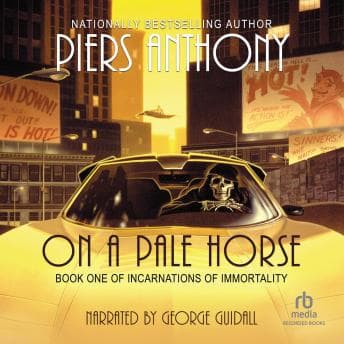
The premise is wild: Zane, our protagonist, is about to end his own life when he accidentally kills Death instead. Now he's stuck with the job. And Piers Anthony doesn't just use this as a cool hook and move on - he actually builds out the entire operational framework of what it means to BE Death. There are rules. There's a quota system. There's literally a pale horse (named Mortis, because of course) that transforms into whatever vehicle the situation requires. It's like someone designed an API for mortality and then wrote a fantasy novel about the guy who has to maintain it.
The System Architecture of the Afterlife
Here's where Anthony really got me: the worldbuilding isn't just decorative. Death has to appear at the moment of passing and weigh souls - literally measure the balance of good and evil in a person's life. But what happens when it's perfectly balanced? Those are the cases Zane has to handle personally. It's essentially edge case management, and as someone who spends her days debugging distributed systems, I found this weirdly satisfying.
The magic-meets-technology angle is dated (this was written in 1983) but in a charming way. Cars that run on magic, automated household systems, a blend of medieval fantasy tropes with near-future tech. It's like someone described the internet to a fantasy author in 1982 and they just... ran with it.
That said - and I have to be honest here - Anthony's prose hasn't aged perfectly. There are moments with the female characters that made me wince. The love interest, Luna, is interesting conceptually (she's a sorceress who literally orchestrated Zane becoming Death as part of a larger plan), but some of the romantic dynamics feel very 1980s Male Gaze. I pushed through because the philosophical core is genuinely compelling, but your mileage may vary.
Guidall Does the Heavy Lifting
George Guidall isn't Ray Porter. But he's solid - really solid. His voice has this gravitas that works perfectly for a story about mortality and cosmic bureaucracy. He brings that same weight to Dark Tower V: Wolves of the Calla, though King gives him way more characters to juggle. When Zane is wrestling with whether to take a life that's balanced on the edge, Guidall brings weight to those moments without going full melodrama.
The pacing is interesting. Some reviewers mentioned he goes a bit fast, and I can see that - there were moments on my morning commute where I had to rewind because I'd zoned out during a particularly dense worldbuilding section. But honestly, at 1.25x speed (my sweet spot for this one), it flowed well. The nearly 13-hour runtime felt appropriate; this isn't a book that could've been a blog post.
One thing I appreciated: Guidall differentiates characters clearly without doing cartoon voices. Death sounds authoritative but uncertain. Luna sounds warm but calculating. Even the minor characters have distinct enough deliveries that I never lost track of who was speaking.
Where It Drags (And Where It Flies)
The middle section has some pacing issues. There's a stretch where Zane is essentially learning the job - visiting dying people, making judgment calls, dealing with the bureaucracy of the afterlife - that feels a bit episodic. Each case is interesting individually, but strung together it loses momentum. Eldest has a similar structure issue - episodic middle that eventually justifies itself - though Paolini takes way longer to get there.
But then Anthony pulls everything together for the finale, and suddenly all those seemingly disconnected cases click into place. It's like watching a refactoring session where messy code suddenly becomes elegant. The climax involves Zane having to make a choice about cosmic-level consequences, and the philosophical groundwork pays off.
Who Gets Value Here
Perfect for: long commutes, flights, any situation where you want something that engages your brain without requiring 100% attention. Skip if: you need fast-paced action or can't tolerate dated gender dynamics.
Final Commit
The ROI on this audiobook is solid if you're into speculative worldbuilding. It's not perfect, but it's a genuinely original concept executed with more care than I expected. I'm probably going to listen to the rest of the series - apparently each book follows a different Incarnation (Time, Fate, War, etc.), and I'm curious how the system scales.
Would I listen again? Probably not immediately. But I'm glad I gave it those six commutes.