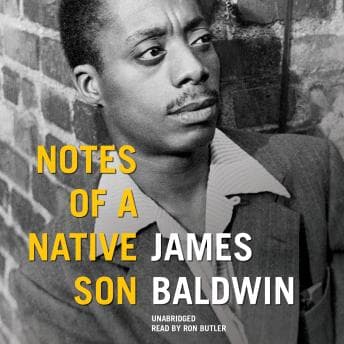

Okay, I need to talk about the narrator situation first because it's driving me a little crazy and I can't just pretend it's not there.
Ron Butler. Ron Butler, Ron Butler, Ron Butler. I went into this wanting to be swept up in Baldwin's prose — prose that, even on the page, reads like someone grabbed you by the collar of your shirt and said listen to me — and for stretches, Butler gets it. He channels this righteous energy, this almost sermonic cadence that Baldwin clearly inherited from his stepfather's pulpit. There are moments, especially in the title essay "Notes of a Native Son," where Butler's voice drops into something low and furious and controlled, and you can feel Baldwin's grief for his father tangled up with his rage at a country that made his father the way he was. Those moments? Electric.
But then — and I hate saying this — there are long passages where something shifts and his delivery goes flat. Not quiet-flat, which can be devastating. More like... mechanical-flat. Like the emotional temperature just drops out of the room. For a five-hour listen, that inconsistency is rough. I kept reaching for my phone to check if my Bluetooth had glitched. It hadn't.
Baldwin Wrote These Essays in His Twenties and I Need Everyone to Sit With That
Let me be clear: the writing itself is staggering. Baldwin was in his twenties when he wrote these. His TWENTIES. I'm over here at thirty-something still struggling to articulate why a particular shade of cerulean makes me feel homesick, and this man was dissecting the entire architecture of American racial consciousness with the precision of a surgeon and the fury of a poet.
The essay "Everybody's Protest Novel" — where he essentially takes apart Uncle Tom's Cabin and, by extension, his own mentor Richard Wright's Native Son — is Baldwin at his most fearless. He's not just critiquing white liberal paternalism. He's saying that even the art meant to save Black people can dehumanize them by reducing them to symbols. And he knew this would cost him friendships. It did. He wrote it anyway. That's the kind of intellectual courage that made me pause my design work, lean back in my chair, and just... stare at my ceiling for a minute.
And then there's the title essay. The one about his father's death coinciding with a Harlem race riot coinciding with the birth of his youngest sibling. Baldwin writes about sitting in a diner in New Jersey and being refused service, and the rage that builds in him — not dramatic rage, not cinematic rage, but the quiet, corrosive kind that eats you from inside — and I was sitting at my desk working on a branding project for some boutique fitness studio, and I had to stop. Because Baldwin describes looking at his own hands after nearly throwing a glass at a waitress and realizing he could become his father, become the bitterness he'd spent his whole life trying to escape. My heart. MY HEART. I thought about my abuela, who never talked about the specific indignities she faced crossing into Texas in the 1960s but who'd get this look sometimes — this faraway, steel-hard look — and I understood that Baldwin was writing about the same silence she carried.
Abuela would have loved this one. Or she would've gotten very quiet listening to it, which was her version of being deeply moved.
The Narrator Divide Is Real and I Get Both Sides
So here's my honest take on the audio experience: this is a book where the writing does about 80% of the emotional heavy lifting on its own. Baldwin's sentences have their own rhythm, their own music. Butler, at his best, rides that rhythm — he leans into the long, winding clauses and lands the gut-punch endings of Baldwin's paragraphs. There's a passage about walking through Paris as a Black American expatriate where Butler's pacing is genuinely beautiful, measured and searching, the way Baldwin himself must have felt.
But I listened to this over three days while working, and I'll be honest — there were stretches in the middle essays where my attention drifted not because Baldwin lost me, but because Butler's delivery leveled out into something too even, too smooth. I've seen people online call his voice robotic and I think that's harsh, but I understand where it comes from. When you're narrating someone whose written voice is THIS alive with contradiction and fire and tenderness, you can't coast. You just can't. And Butler coasts sometimes.
At 1.0x speed, which is the only speed I do, the five hours felt right for the density of the material. This is not a background listen. Don't put this on while you're cooking or driving carpool. This demands your full brain. That same kind of unrelenting emotional density hit me when I listened to Tweak: Growing Up on Methamphetamines — another memoir that requires you to just sit there and take it.
Who This Is For (and Who Should Maybe Read the Print Instead)
If you've never read Baldwin: start here. Not because it's easy — it's not — but because these essays are the foundation. They're where he figured out how to be James Baldwin on the page. If you want the audiobook specifically, go in knowing the narration is uneven. The highs are genuinely affecting. The lows are noticeable. If you're someone who needs a narrator like Julia Whelan or Bahni Turpin — someone who makes every single sentence feel like a living thing — you might find yourself frustrated.
But the writing. God, the writing. This book felt like someone turning on every light in a dark house, room by room, unflinching about what the light reveals.
Frida Knocked My Headphones Off the Desk Twice During This and Honestly, Fair
I'm giving the audiobook a slightly lower score than I'd give the book itself, and that distinction matters. Baldwin's essays are a permanent five. This particular audio production, with Butler's hit-or-miss delivery, lands lower. But I still think it's worth hearing Baldwin's words spoken aloud — there's something about the oral tradition of these essays, the way they were clearly written to be heard, that the audio format honors even when the narrator stumbles. Just know what you're getting into.