
"Get comfortable being uncomfortable."
That line hit me somewhere around hour two, and I had to pause my screen, set down my stylus, and just sit with it. I was knee-deep in a rebrand project with a tight deadline, Diego curled on the keyboard like he owned the place, and this book - this quiet, unglamorous companion to No Easy Day - just knocked the wind out of me with something that simple.
Here's the thing. I don't typically reach for military memoirs. My shelves (digital and otherwise) lean heavily toward romance and contemporary fiction, books that let me feel the messy, tender parts of being human. But my cousin Marco, who did two tours in Afghanistan, told me over Christmas tamales that this book changed how he talked about his service. And Marco doesn't talk about his service. So I listened.
The Missions Nobody Clapped For
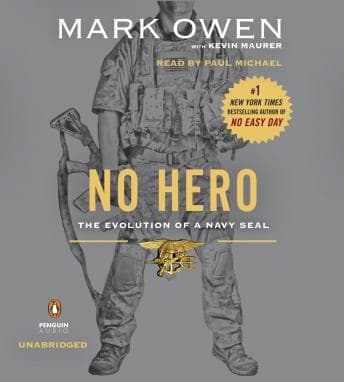
No Hero isn't about the Bin Laden raid. That's what No Easy Day was for. This book is about the in-between - the blown operations, the teammates who didn't come home, the long stretches of monotony punctuated by absolute terror. Mark Owen writes about a mission in Afghanistan where his team breached a compound only to find children sleeping feet away from where they were operating, and the weight of that proximity, the constant calculation of who lives and who dies, sits heavy on the page. There's a passage where Owen describes a stray cat lapping up blood from a dead insurgent while a young boy watches from a doorway, and I literally stopped chewing my food. That image hasn't left me.
What got me emotionally wasn't the action sequences - though those are sharp and vivid - but the quieter admissions. Owen talking about the guilt of missing his family, the way he'd come home and feel like a stranger in his own life. The slow erosion of normal. That's the stuff that cracked me open because it's universal, right? You don't have to be a SEAL to know what it feels like to sacrifice parts of yourself for something bigger and then wonder if you can get those parts back. Locking Up Our Own cracked me open in that same particular way — a totally different world on the surface, but underneath it's the same painful question about what systems ask of people and what never gets returned.
I cried once. Chapter toward the end, where he reflects on teammates lost. Not my usual four-tissue affair, but a real, quiet cry - the kind where your throat just tightens and you blink a lot and your cat looks at you like you're broken. (Frida did look at me like I was broken.)
Paul Michael's Baritone Does the Heavy Lifting
So here's where it gets interesting. The first book, No Easy Day, was narrated by Holter Graham, and I know some listeners were disappointed by the switch. I never heard Graham's version, so I came in clean, and honestly? Paul Michael is really good at this. His baritone has this lived-in quality - not performative military-tough-guy, but steady. Grounded. Like your uncle who served and tells you stories on the porch without flinching but also without bragging.
His pacing matches Owen's conversational writing style perfectly. He doesn't rush the combat scenes or drag the reflective ones. There's a moment where Owen describes the sensory overload of a nighttime raid - the smell of cordite, the green glow of night vision, the sound of his own breathing - and Michael reads it with this controlled tension that had me gripping my desk. He's not trying to be cinematic. He's trying to be honest. And that restraint is exactly what a book like this needs.
That said - his dialogue work is functional, not spectacular. When Owen quotes teammates, Michael gives them slightly different registers but nothing dramatically distinct. For a single-narrator memoir, though, it works. You're hearing one man's perspective, and Michael keeps it anchored in that singular voice.
Who This Is Really For
If you need plot twists and cliffhangers, this isn't your book. It's episodic, chapter by chapter, mission by mission, and the structure is more like a series of essays than a thriller. Some chapters hit harder than others - the early training sections dragged slightly for me compared to the deployment chapters - but the emotional throughline holds.
This is for people who want to understand what service costs on a personal level. For people like my cousin Marco who need to hear someone else say the quiet parts out loud. For listeners who believe that courage isn't the absence of fear but the decision to keep showing up anyway. Abuela wouldn't have understood the military specifics, but she would've understood the sacrifice. She would've lit a candle for every name Owen mentions.
If you're coming from No Easy Day expecting the same adrenaline, recalibrate. This is the slower, more honest sibling. Less headline, more heart.
Light a Candle, Keep Listening
At six hours and forty-one minutes, this is a focused listen - tight enough for a long design day, substantial enough to sit with afterward. I finished it on a Tuesday night, closed my laptop, and texted Marco: "I get it now. A little." He sent back a thumbs up, which from him is basically a novel.
Get comfortable being uncomfortable. That's the whole book in five words. And sometimes that's enough.








![Steve Jobs [unabridged audiobook] audiobook cover](/_next/image?url=https%3A%2F%2Fcovers.audiobooks.com%2Fimages%2Fcovers%2Ffull%2F9788499923406.jpg&w=1920&q=75)