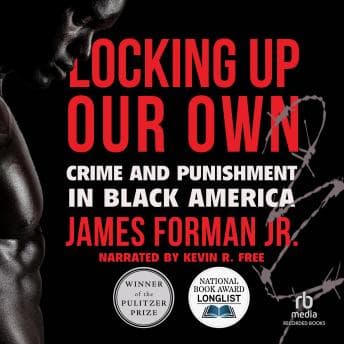
Let me cut to the chase: this book made me rethink twenty-five years of assumptions about crime policy in America. That's not something I say lightly.
I finished this one on a late-night drive back from a client site in Houston. Three hours of empty highway, Ranger snoring in the back seat, and James Forman Jr. laying out a history I thought I understood but clearly didn't. By the time I pulled into my driveway, I sat there for another ten minutes just processing.
The Uncomfortable Truth Nobody Wants to Hear
Here's what got me: Forman isn't pointing fingers at the usual suspects. He's a former public defender, Yale law professor, the whole package—and he's making the case that Black leaders in cities like D.C. actively pushed for the tough-on-crime policies that devastated their own communities. Marion Barry. Eric Holder before he became Attorney General. City council members, police chiefs, community activists. They saw the crack epidemic, the murder rates, the open-air drug markets, and they made choices.
Were those choices wrong? Forman doesn't give you an easy answer. That's what I respect about this book. He shows you the 1970s and 80s through the eyes of people watching their neighborhoods burn—sometimes literally—and asking what the hell they were supposed to do about it. The civil rights gains they'd fought for were being undermined by chaos on the streets. They chose order.
The consequences? Catastrophic. Mass incarceration. Broken families. Generational trauma. Forman knows this intimately from his years defending people caught in the system he's describing.
When History Gets Personal
Forman weaves his own courtroom experiences throughout the narrative, and this is where the book becomes something more than academic analysis. He's not just citing statistics—he's telling you about the kid he couldn't save, the mandatory minimum that made no sense, the judge who had no choice but to hand down a sentence everyone in the room knew was unjust.
I've seen this scenario play out in real life, just from a different angle. That tension between principle and practice runs through The Art of War too, though Sun Tzu never had to reckon with the human cost quite like Forman does here. Military justice has its own version of this problem—rules that make sense in the abstract becoming instruments of destruction when applied to actual human beings. Forman gets that tension. He's not naive about the need for law and order (something I appreciate), but he's clear-eyed about what happens when fear drives policy.
The section on how "Black-on-Black crime" became a political talking point—used by Black leaders themselves to justify harsher penalties—hit different than I expected. Forman traces how a legitimate community concern got weaponized into something that ultimately harmed the people it was meant to protect.
Kevin R. Free Delivers the Mission
The narration is solid. Kevin R. Free has a clear, measured delivery that suits the material. This isn't a book that needs dramatic performance—it needs a voice that can carry you through complex arguments without getting in the way. Free does exactly that. No vocal gymnastics, no distracting accents, just clean storytelling that lets Forman's research and personal experience do the heavy lifting.
At just under nine hours, it's a reasonable commitment. I listened at 1.25x as usual, and the pacing worked well. Free's delivery is deliberate enough that speeding up doesn't lose you any content.
Who This Is For—And Who Should Stand Down
This one requires focus. Not background material. You're going to want to be paying attention when Forman explains the political calculus that led Black officials to support gun control measures then used to target Black citizens, or when he breaks down why "just say no" campaigns originated in Black communities before Reagan made them national policy.
If you're looking for simple villains and easy answers, look elsewhere. Forman's thesis is uncomfortable for everyone—progressives who want to blame only white politicians, conservatives who think tough-on-crime was purely a law-and-order success story. He's asking you to sit with complexity, and that's not always pleasant. Skip this if you need your worldview confirmed rather than challenged.
But if you want to understand how we got here—really understand it, not just the Twitter version—this is essential listening. The Pulitzer wasn't a participation trophy.
After Action Report
I've read a lot about criminal justice reform. Most of it falls into predictable camps. Forman wrote something different—a book that takes seriously both the fear that drove harsh policies and the devastation those policies caused. He doesn't let anyone off the hook, including himself.
Ranger approved this one. So do I. Worth your time? Absolutely. Just don't expect to feel good about it.









![Steve Jobs [unabridged audiobook] audiobook cover](/_next/image?url=https%3A%2F%2Fcovers.audiobooks.com%2Fimages%2Fcovers%2Ffull%2F9788499923406.jpg&w=1920&q=75)