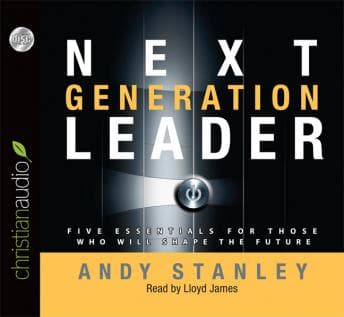

Andy Stanley's Next Generation Leader is a five-hour leadership primer that knows exactly what it is and doesn't pretend to be anything else. That's both its greatest strength and its limitation.
I started this one during a Saturday morning lakefront walk with Denise - she was on a phone call with her sister, I had my earbuds in, and Stanley's framework clicked into place against the gray November water like a clean outline on a whiteboard. Courage, clarity, competence, coachability, character. Five C's. Neat. Organized. The kind of structure my students would appreciate if I could ever get them to care about organizational frameworks the way they care about their phones.
The Sermon You Actually Wanted to Hear
Here's what Stanley does well: he strips leadership advice down to principles that are portable. The section on leveraging uncertainty - specifically his argument that leaders shouldn't wait for complete information before acting - hit me in a way I didn't expect. I've been teaching for twenty years, and every September I stand in front of a new batch of kids and make decisions with maybe 60% of the information I need about who they are and what they need. Stanley would call that a feature, not a bug. He argues that the willingness to move forward in uncertainty is what separates leaders from managers, and he backs it up with enough pastoral anecdote to make it stick.
The coachability chapter is the one I keep thinking about. Stanley's insistence that leaders need to actively seek out mentors and submit to correction - that's countercultural in a world that worships the self-made myth. He's drawing from two decades of church leadership, and you can feel the weight of real experience behind lines about how character failures in private eventually become public disasters. This isn't abstract theory. The man has watched leaders flame out, and he's trying to hand you the fire extinguisher before you need it.
But - and this is where the book bumps up against its own ceiling - it's also a book that was originally published in 2003 and repackaged. Some of the examples feel like they're from a different era, not because the principles are wrong, but because the illustrations haven't been updated to match the world these "next generation" leaders are actually navigating. The framework is sound. The wallpaper is dated. I ran into a similar dynamic reviewing Painter's Daughter - solid bones, but the surface details occasionally reminded you of when it was made.
Lloyd James Does the Work Without Getting in the Way
Lloyd James narrates with what I'd call professional steadiness. His voice is clear, unhurried, and companionable - like a pastor who's had enough coffee but not too much. He doesn't try to perform Stanley's personality, which is the right call. This is instructional material, and James treats it that way. Clean delivery, good pacing, no vocal fireworks.
That said, there's a trade-off. The narration is so even-keeled that during the more anecdotal passages - the stories where Stanley is clearly animated on the page - James doesn't quite lean into the emotional gear shifts. It's competent without being electric. For a five-hour listen, that's fine. You're here for content, not theater. But I found myself wishing for just a little more vocal variation during the courage chapter, where Stanley is essentially preaching about fear, and the material deserves some heat behind it.
The prose deserves to be savored? Not exactly. But it deserves to be absorbed. And James gives you the space to do that.
Who This Is Actually For (And Who Should Keep Walking)
If you're a young leader in ministry or the marketplace - Stanley's phrase, not mine - and you want a concise, principled framework without wading through a 400-page business book, this delivers. Five hours. Five concepts. Done. It's the kind of book I'd hand to a student teacher or a first-year department head and say, "Read this before you make the mistakes I made."
If you've already consumed a shelf of leadership books - Collins, Covey, Maxwell - you'll find the territory familiar. Stanley's Christian perspective gives it a different moral foundation than most secular leadership texts, but the tactical advice overlaps significantly. And if you're looking for deep theological engagement with what it means to lead as a person of faith, this stays more practical than philosophical. Which is intentional. But worth knowing.
My students would probably call this a TED Talk stretched to book length. They're not entirely wrong. But sometimes a clear, direct voice saying obvious-but-important things is exactly what you need at 11 PM when you're wondering if you're doing any of this right.
The Grade I'd Put in the Gradebook
Solid B+. Stanley is a clear thinker and an honest communicator, and at five hours, the book respects your time. It won't change the way you see the world, but it might change the way you show up on Monday morning. For a repackaged 2003 release, it holds up better than it has any right to. Just don't expect revelation - expect practical wisdom delivered without pretense. That's enough.