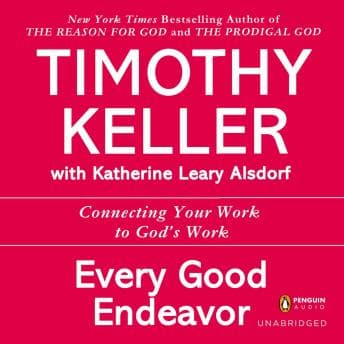

How many business books have you read that promised to give your work meaning—and then delivered nothing but productivity hacks dressed up in inspirational language?
I was prepping for a Sunday strategy session with a fintech founder who keeps asking me why his team seems so disengaged. Pulled up this audiobook because I'd heard Keller referenced in a few faith-based entrepreneurship circles. Eight hours later, I'm rethinking how I frame the entire conversation.
The Framework That Actually Holds Up
Here's what Keller does that most work-meaning books don't: he starts with a theology of work, not a psychology of motivation. The distinction matters. Most books in this space tell you to "find your passion" or "align with your values"—advice that sounds great until you're an accountant at a mid-sized firm wondering what passion has to do with quarterly reconciliations.
Keller argues that work itself—the act of cultivating, creating, serving—is fundamentally good. Not because it makes you feel fulfilled, but because it participates in something larger. He traces this back to Genesis, before the Fall, when Adam was given work to do in a perfect world. Work wasn't the curse. The curse was work becoming toilsome.
This reframe hit different for me. My parents didn't have time for "passion." They pressed clothes and smiled at customers and kept the doors open. Keller would say they were doing exactly what work is supposed to do—serving others, creating order, participating in God's ongoing work of maintaining the world. That's not a consolation prize. That's the point.
Where Keller Gets Specific (And Where He Doesn't)
The middle sections dig into practical applications—how to handle ethical dilemmas, how to think about ambition, how to serve in a "cutthroat, bottom-line-oriented workplace" (his words). He's clearly been counseling Manhattan professionals for decades, and it shows. The examples feel lived-in rather than theoretical.
But—and this is my main critique—some of the application sections run long. Keller has a pastoral instinct to cover every angle, address every objection. Good for a sermon series. Less efficient for an audiobook you're trying to absorb during a Sunday afternoon work session. I found myself wishing he'd trust his readers more. The key insights could've been delivered in half the time.
Jenny would say I'm being harsh. Jenny is right. But also, I'm not wrong.
Lloyd James Does the Job
Lloyd James narrates with the kind of measured, clear delivery you want for theological content. No dramatic flourishes, no attempts to make it more exciting than it is. He conveys Keller's intellectual depth without getting in the way. It's the audio equivalent of a well-designed book—you notice the content, not the container.
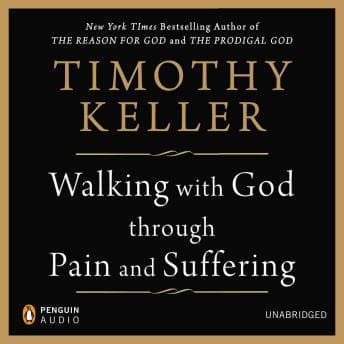
James brings that same understated steadiness to Walking with God through Pain and Suffering—another Keller title where the weight of the material demands a narrator who gets out of the way.Not a performance you'll remember, though. Single narrator, no sound effects, no production bells and whistles. Just a man reading a thoughtful book. At 2.0x speed, it clocked in around four hours, which felt right for the density of the material.
Who Gets the Most From This (And Who Should Skip)
If you're a Christian professional wrestling with whether your work matters—especially if you're not in "ministry" or the nonprofit sector—this book was written for you. Keller specifically addresses the guilt some believers feel about working in finance, law, tech, or other fields that don't feel obviously "spiritual."
His Prayer: Experiencing Awe and Intimacy with God covers adjacent territory for readers who want to stay in that same theological headspace—less vocational, more devotional, but the same rigorous framework underneath.If you're not religious, skip it. The framework is explicitly biblical, and while Keller's reasoning is intellectually rigorous, the foundation won't land if you don't share his starting premises. There are better secular options for finding meaning in work.
If you're a manager or consultant (like me) working with faith-based founders or teams, this is useful context. Understanding how thoughtful Christians think about vocation helps you ask better questions and avoid tone-deaf advice.
The Dry Cleaner Test
I measure every business book against my parents' real-world hustle. Most fail. This one passes—not because it would've given them new strategies, but because it would've named what they were already doing. They didn't need a theology of work. They lived one.
Keller just wrote it down.
Park's Bottom Line
The core framework—work as service, not self-expression—is worth the listen. Chapters 1-4 and 9-10 carry the weight. The middle sections are good but could be tighter. If you're a Christian professional feeling like your faith and your career exist in separate boxes, this book builds the bridge.
Skip to chapter 5 if you want the practical applications. But honestly? Don't skip the theology. It's what makes the rest of it stick.