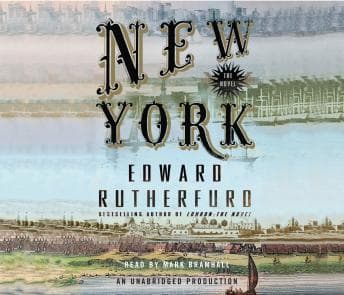

Thirty-seven hours. Let me say that again. Thirty-seven hours and seventeen minutes. That's not an audiobook - that's a relationship. And I need to talk about why Edward Rutherfurd's New York: The Novel made me resent every other book on my shelf for not being ambitious enough, while also making me want to shake Rutherfurd by the shoulders at least twice.
Here's my complaint: Rutherfurd doesn't trust you to feel the weight of history. He insists on showing you. Every. Single. Layer. There's a scene - and I won't spoil the specifics - where a Dutch family in 1660s New Amsterdam is arguing about land rights, and you think okay, this is a property dispute, but then generations later that same plot of land becomes the fulcrum for a Revolutionary War subplot, and then again it surfaces during the Gilded Age, and by the time you're watching the same piece of Manhattan real estate get discussed in a post-9/11 boardroom, you realize Rutherfurd has been playing a game with you that spans four hundred years. It's maddening and brilliant. My students would hate this. I love it.
Rutherfurd's Trick: The Family Tree as American History
If you loved James Michener's Hawaii or Chesapeake, this is their spiritual successor - but with sharper characterization and a narrower geographic lens that paradoxically makes the scope feel bigger. Rutherfurd tracks a handful of families across centuries: Dutch settlers, English merchants, Irish immigrants, African Americans both free and enslaved, Italian arrivals, Jewish families. The conceit is that New York's story IS the story of these intersecting bloodlines.
What separates this from a textbook with dialogue is that Rutherfurd gives each generation its own emotional logic. The motivations of a fur trader in 1700 feel genuinely different from those of a Tammany Hall operator in 1890 - not because Rutherfurd is showing off his research (though the research is staggering), but because he understands that ambition, loyalty, and survival mean different things depending on which version of New York you're trying to survive in. This is why we still read the classics - or at least, why we still read the books that aspire to be classics. Dostoevsky figured that out a long time ago - the reason The Brothers Karamazov still feels alive after a hundred and forty years is exactly this: every character operates from a moral logic that belongs specifically to them, not to the author's thesis.
But here's where I'll push back. The 20th century sections feel rushed compared to the colonial and 19th century material. Rutherfurd spends luxurious hours on the Revolutionary War period, letting you sit inside the occupied city, smell the harbor, understand the specific terror of divided loyalties. Then suddenly you're sprinting through the Depression, World War II, the 1970s collapse, and 9/11 in what feels like half the time. The prose deserves to be savored, and it felt like Rutherfurd himself got tired of savoring around hour thirty.
Mark Bramhall Earned Every One of Those Audie Awards
Let's talk about Bramhall, because this performance is the reason you listen to this instead of reading the print edition. Thirty-seven hours with a single narrator means you're essentially locked in a room with one human being for longer than most people spend on a vacation. Bramhall doesn't just survive that marathon - he turns it into something close to a one-man show.
The narrator understands that pause is punctuation. Bramhall shifts between Dutch-accented merchants, Irish brogues, Italian immigrants, and upper-crust WASP drawls, and what's remarkable is how he uses accent as shorthand for class without making it cartoonish. His voice for the wealthy Master family across generations carries this particular clipped authority - you can hear inherited privilege in the vowels. Meanwhile his Irish characters have a warmth and forward momentum in their speech that tells you something about desperation and hope before the dialogue even gets there. An ancient grandmother in 1800s Five Points doesn't sound like a young woman arriving at Ellis Island in 1900, and neither sounds like anyone in the Dutch colonial chapters. That's not just range - that's interpretation. That's a narrator who read the book and thought about it before he ever sat down in the booth.
I listened to most of this at 1.0x while grading end-of-semester essays, which means I was simultaneously experiencing the founding of New York and the destruction of the English language by sixteen-year-olds. The contrast was... instructive. But the last five hours I saved for a Saturday walk along the lakefront with Denise, and something about hearing the 9/11 chapters while looking out over Lake Michigan - another great American body of water, another city that reinvented itself after disaster - hit different than I expected. Denise asked why I was quiet. I blamed the wind.
Who Gets the Assignment (And Who Gets a Pass)
This is a commitment book. If you want something you can pick up and put down casually, this isn't it - you'll lose track of which generation you're in, which family branch is which, and why that street name matters. But if you're the kind of listener who wants to understand a place through its people, who likes watching the same human impulses play out across centuries, who believes that a city is really just a collection of stories stacked on top of each other like geological strata - worth pausing the faculty meeting for. Multiple faculty meetings.
Skip it if generational sagas make you impatient, or if you need a single protagonist to anchor you. This book doesn't have a main character. New York is the main character. (Yes, I know how that sounds. Rutherfurd would probably put it on the cover if he could.)
The Annotated Margin Note
This reminds me of what Hemingway said about Paris - that it was a moveable feast, something you carried with you forever after living there. Rutherfurd makes the argument that New York is the same, except you don't have to live there. You just have to listen for thirty-seven hours. And honestly? I'd do it again. Maybe not during budget season, but I'd do it again.