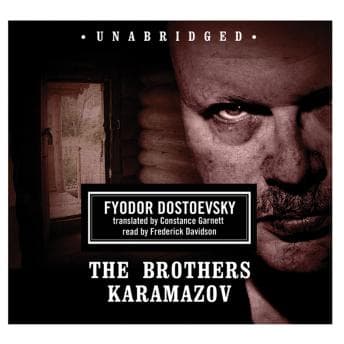

The Grand Inquisitor chapter hit me around hour eighteen, somewhere between grading a stack of sophomore essays on The Great Gatsby and wondering if Principal Martinez would notice if I just... didn't show up tomorrow. Ivan's monologue about suffering children and the impossibility of divine justice landed like a punch I didn't see coming. I actually stopped marking papers. Just sat there in my kitchen at 11:47 PM, red pen frozen mid-circle, thinking about theodicy for the first time since grad school.
This is why we still read the classics. Not because they're assigned or prestigious, but because Dostoevsky—writing in 1880—understood something about doubt and faith that my theology professors couldn't articulate in four years of seminary-adjacent coursework. That same psychological precision shows up in Works of Edgar Allan Poe, Raven Edition, Volume 1, though Poe's darkness runs more Gothic than theological.
Thirty-Five Hours With the Karamazov Mess
Let's talk about what we're actually dealing with here. Nearly thirty-five hours of Russian psychological warfare disguised as a family drama. Four brothers—Dmitri the passionate disaster, Ivan the intellectual in freefall, Alyosha the gentle believer, and Smerdyakov the silent knife waiting to drop. Their father Fyodor Pavlovich is one of literature's most genuinely repulsive creations. Not cartoonishly evil. Just... human in the worst possible ways. The kind of man who makes you understand patricide as a philosophical position rather than a crime.
Dostoevsky doesn't flinch. That's the thing my students need to understand when I teach excerpts from this. He looks at cruelty, at faith, at the absolute mess of human motivation, and he just... keeps looking. The courtroom scenes in the final third are devastating not because of what happens, but because of what they reveal about how badly we want simple answers to complicated questions.
Frederick Davidson's Problematic Gift
Here's where I have to be honest with you. Davidson's narration is a complicated beast.
His British accent—somewhat posh, definitely theatrical—creates an interesting tension with Russian source material. There's something almost John Hurt-esque about his delivery, this gravelly precision that works beautifully for the philosophical dialogues. When Ivan is losing his mind in those late chapters, Davidson's measured, almost clinical reading somehow makes the psychological disintegration more terrifying. The man understands that pause is punctuation.
But.
His pacing has these strange hitches. Pauses land in wrong places. Mid-sentence breaks that feel like he's reading ahead to figure out what comes next. For a book that already demands serious concentration, these rhythmic stumbles can pull you right out of Dostoevsky's spell. I caught myself rewinding multiple times during the Grushenka-Katerina confrontation because I'd drifted during one of his odd hesitations.
He differentiates characters well enough—you always know who's speaking—but there's a certain... smugness? to his default register that some listeners will find grating. I didn't hate it. But I understand why some do.
The Commitment This Book Demands
My students would hate this. I love it.
This is not background listening. This is not your commute audiobook. This is you, alone, probably late at night, giving Dostoevsky the attention he's demanding. I tried listening during faculty meetings (sorry, Martinez) and realized I was retaining nothing. The themes are too dense, the philosophical arguments too layered, for divided attention.
Constance Garnett's translation—yes, I know, the purists will argue for Pevear and Volokhonsky—has a Victorian formality that pairs surprisingly well with Davidson's delivery. It feels like reading a classic should feel. Weighty. Deliberate. Worth pausing for.
Speed recommendation? Absolutely not. Listen at 1.0x. The author chose those words. Dostoevsky spent years in a Siberian prison camp developing the psychological insight that powers this novel. The least you can do is hear it properly.
Who Will Love This (And Who Should Run)
If you loved Crime and Punishment but wanted more theological wrestling and family dysfunction, this is its spiritual successor—and its superior, honestly. If you've been meaning to tackle Dostoevsky and want the full experience, this is the mountain worth climbing.
If you need fast pacing, clear moral answers, or a narrator with American inflections, look elsewhere. If philosophical dialogues that run for entire chapters make you antsy, this will test your patience. If you're hoping for background listening while doing dishes, you'll finish thirty-five hours having absorbed maybe four hours of actual content.
Worth Every Ungraded Essay
The Brothers Karamazov is Dostoevsky's final argument about what it means to be human, to doubt, to believe anyway. Davidson's narration is imperfect—those pauses, that occasional smugness—but his emotional delivery during the crucial scenes (Ivan's breakdown, the courtroom drama, Alyosha's quiet faith) elevates the material more often than it detracts.
This isn't a casual listen. It's a commitment. Thirty-five hours of your life, ideally given during quiet moments when you can actually think. But if you've ever wondered why we still teach the Russians, why these dead authors still matter—this is your answer.
Denise found me at midnight, still sitting at the kitchen table, essays ungraded, staring at nothing. "The Grand Inquisitor?" she asked. She knows me too well.
Yeah. The Grand Inquisitor.