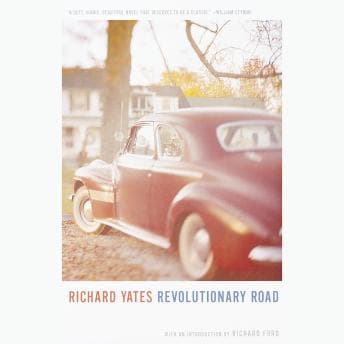

I was walking the lakefront with Denise last Saturday — one of those gray Chicago mornings where the lake looks like hammered tin and you can smell winter coming even though it's technically still fall. She was talking about her sister's kitchen renovation, and I was nodding at appropriate intervals, but somewhere around mile two I stopped hearing her entirely. April Wheeler had just told Frank about Paris, and the hope in her voice — the way Bramhall pitched it just slightly too bright, like a lightbulb before it burns out — made me stop walking.
Denise noticed. She said, "You're doing that thing again where you look like someone died." I told her nobody died. Not yet. But I knew it was coming.
The Wheelers Are Every Couple Who Ever Said "We're Different"
Here's what Yates understood better than almost anyone writing in the twentieth century: the most dangerous lie isn't the one you tell other people. It's the one you build a marriage on. Frank and April Wheeler aren't villains. They're not even particularly flawed in any dramatic way. They're just two people who decided early on that they were special — that suburban Connecticut was a temporary stop, that real life was waiting somewhere more interesting — and then slowly, quietly, catastrophically failed to prove it.
The prose deserves to be savored. Yates writes about the 1950s suburbs the way a surgeon describes an incision — precise, clinical, but with full awareness that something living is being cut open. There's a scene early on where Frank and April first look at the house on Revolutionary Road, and Bramhall captures this exact tone of forced cheerfulness, the way couples perform enthusiasm for each other when they're both terrified they're making a mistake. It's not a big dramatic moment. It's just two people lying to themselves in real time. And it's devastating.
Kurt Vonnegut called this "the Great Gatsby of my time," and I used to think that was generous. I don't anymore. Both books are about the American talent for self-invention turning toxic. But where Gatsby is romantic even in its tragedy — there's something gorgeous about reaching for that green light — Revolutionary Road offers no such comfort. The Wheelers aren't reaching for anything. They're just convinced they shouldn't have to.
Bramhall Turns a One-Man Booth Into a Full Dinner Party
Let's talk about what Mark Bramhall does with this material, because it's remarkable. This is a single-narrator production, but you'd swear there are six people in the room. He gives Frank this slightly performative baritone — the voice of a man who's always auditioning for a version of himself he saw in a movie once. April gets something cooler, more contained, like she's holding everything at arm's length until she can't anymore. And then there's Shep Campbell, the neighbor, who Bramhall voices with this eager, slightly desperate warmth that made me think of every guy I've ever known who laughs too hard at his own jokes because he's afraid of silence.
But the real performance happens in Chapter 7 of Part 3, when Yates shifts the narration to April's point of view. I won't spoil what happens, but Bramhall drops every affectation, every character trick, and just reads with this quiet gravity that reminded me — and I don't say this lightly — of the last pages of Gatsby. That moment where the narrator steps back and lets the weight of everything just... land. The narrator understands that pause is punctuation. And Bramhall earns every second of silence.
Why My Students Would Hate This (And Why That's the Point)
My students would hate this. I love it. They'd call it slow. They'd say "nothing happens." And they'd be wrong in the way that only seventeen-year-olds can be wrong — technically correct and spiritually miles off. Because everything happens in this book. It just happens in kitchens and bedrooms and at cocktail parties where everyone's three drinks in and one honest sentence away from destroying a friendship.
Some listeners have said they found it boring, that the movie was better. I get it — the Sam Mendes film is gorgeous, and DiCaprio and Winslet bring a visual intensity that's hard to replicate in audio. But here's what the audiobook gives you that the film can't: Yates's interior monologues, the way he crawls inside Frank's rationalizations and lets you watch a man construct his own prison brick by brick. You don't just see Frank make bad choices. You hear him convince himself they're good ones. At 1.0x speed. Because you need every word.
This is why we still read the classics. Not because they're old. Because they're still true. I had a similar reckoning with As Bright as Heaven — a completely different setting and era, but the same gut-punch of recognizing that ordinary people living ordinary lives is somehow the most devastating story fiction can tell.
Who Should Listen — And Who Should Run
If you loved The Great Gatsby, this is its spiritual successor — darker, angrier, and without the mercy of a green light to reach for. If you appreciate character-driven fiction where the tension comes from people slowly failing each other, this is eleven hours you won't regret.
But if you need plot momentum — car chases, revelations, twists — you'll struggle. This is a book about the violence of ordinary life. It moves at the speed of a marriage falling apart, which is to say: imperceptibly, until suddenly it's too late.
Worth pausing the faculty meeting for. Worth pausing everything for.
The Assignment I'd Give If Anyone Were Listening
I've been teaching for twenty years. I've watched kids pretend to understand Fitzgerald, fake their way through Hemingway essays, and sleep through my Faulkner podcast episodes right alongside my mother. But if I could assign one book that captures the quiet American terror of settling — of waking up at forty and realizing you've been performing your own life instead of living it — it would be this one. Bramhall's narration doesn't just deliver the text. He interprets it. And the interpretation is flawless.
Denise asked me what the book was about when we got home. I said, "Us. All of us." She gave me that look she gives me when I'm being dramatic. But I meant it.