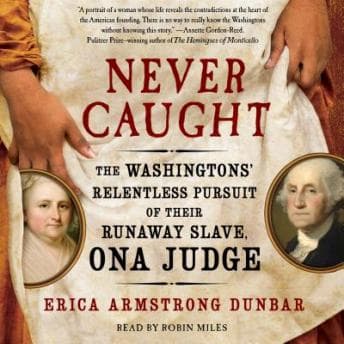

Everyone knows George Washington. The cherry tree, the wooden teeth myth, the founding father on the dollar bill. What most people don't know - what I didn't fully know until I listened to this - is that the man who wrote about liberty was also running an active manhunt for a twenty-two-year-old woman whose only crime was wanting to be free.
I listened to this on a Saturday morning while I was doing laundry and making my kids' lunches. Folding towels, packing sandwiches, listening to Erica Armstrong Dunbar lay out exactly how Washington used the postal system, his personal contacts, and the full weight of the presidency to chase down Ona Judge across state lines. I had to stop folding at one point. Just stood there holding a dish towel.
The History They Didn't Teach You in Civics Class
Here's the part that got me: Washington didn't just own enslaved people - he engineered a workaround to Pennsylvania's gradual emancipation law. Every six months, he rotated his enslaved household staff back to Virginia before their legal clock could expire. Deliberately. Methodically. With full knowledge of what he was doing. Dunbar doesn't editorialize much - she doesn't have to. She just lays out the documented facts and lets you sit with them.
Ona Judge herself is the through-line, and Dunbar does something I genuinely appreciate as someone who spends a lot of time reading between the lines of what people don't say: she's honest about the gaps. The historical record on Ona is incomplete because enslaved people's inner lives were rarely documented by the people who owned them. Dunbar works with what exists - newspaper ads, letters, two interviews Ona gave in her old age - and she's transparent about where she's inferring versus where she has documentation. That kind of intellectual honesty is rarer than it should be. Though I'll say, after sitting with a memoir like Under the Black Hat, where someone is also working hard to separate myth from documented reality about a larger-than-life figure, I've come to appreciate just how much craft that kind of restraint actually takes.
The book runs just under seven hours, which is the right length. It's dense but not overwhelming. I did notice what some other listeners flagged - there are stretches where the narrative pulls away from Ona to contextualize the broader Washington household or other figures, and those sections drag a little compared to the chapters focused directly on her. The section on William Costin's family, for instance - historically significant, but I felt the momentum shift. It reads like a historian making sure she documents everything she found, which is admirable and occasionally slows things down.
Robin Miles Keeps Her Dignity Intact
Robin Miles narrates this with a steadiness that matches the material. She doesn't perform the outrage for you - she trusts you to feel it yourself. Her pacing is measured and clear, which is exactly what you want when the content is this heavy. This isn't a book that benefits from dramatic flourishes. It benefits from someone who reads it like they believe every word, and Miles does.
No audio issues, no production complaints. Straightforward and clean. For a history book where you need to actually absorb information, that matters more than people give it credit for.
Who Ona Judge Deserved to Be
What stays with me - what I was still thinking about while I made dinner that night - is that Ona Judge escaped and was never recaptured, but she also never got to live freely. She spent decades in New Hampshire, poor, hiding in plain sight, repeatedly refusing to return even when Washington's agents found her. She gave two interviews near the end of her life. She said she had no regrets.
Dunbar's achievement here is making sure Ona Judge is a person and not just a footnote. She had a husband. Children. A whole life she built in the margins of a country that was still legally hunting her.
Carlos asked why I was quiet at dinner. I said I was thinking about work. Technically true.
If you want the comfortable version of American history, this is not your book. If you want the documented, sourced, unflinching version - the one where the founding father is also the man who ran a six-month rotation scheme to keep human beings from becoming legally free - this is exactly your book. My mom would love this. She'd also probably call me afterward to talk about it for an hour, which I would not mind at all.