
What kind of man walks on the moon and then spends the rest of his life trying to avoid talking about it?
That question rattled around in my head for most of this listen. I was up late dealing with a proposal for a client's threat assessment — one of those nights where the work's done but the brain won't shut off — and I put this on around midnight thinking it'd ease me into sleep. Instead I was still listening at 0300, sitting in my office with Ranger snoring at my feet and a cold cup of coffee I'd forgotten about.
The Guy Who Flew Combat at 20 and the Moon at 38
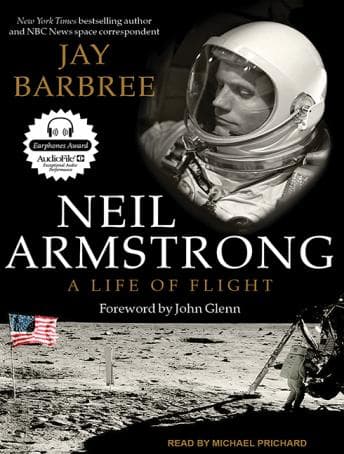
Let me cut to the chase: Jay Barbree knew Neil Armstrong for fifty years, covered every manned spaceflight for NBC, and was literally standing on the ground watching when Armstrong's missions launched. That's not a biographer's relationship — that's a foxhole buddy writing about his friend. And you can feel it. Barbree doesn't worship Armstrong; he understands him. There's a difference.
What hit me hardest was the Korean War section. Armstrong flew 78 combat missions in F9F Panthers off the USS Essex. Barbree describes a mission where Armstrong's Panther caught an anti-aircraft cable stretched across a valley — sheered six feet off his right wing — and he still nursed that jet back to friendly territory before ejecting. Twenty years old. The author clearly did their homework here, and the technical details are right. He doesn't call things by the wrong names or romanticize combat flying into something it isn't. As someone who's been on the receiving end of ground fire (different airframe, different war, same pucker factor), I appreciated that restraint.
The Gemini 8 emergency is where the book really earns its keep. Armstrong and Dave Scott are tumbling at one revolution per second — that's a death spiral in orbit, for those keeping score — and Armstrong methodically works through the problem, kills the OAMS thrusters, fires the reentry system to stabilize. Barbree reconstructs this sequence with a 'you are there' immediacy that works because he was actually there in the press pool, listening to the comms in real time. He's not imagining what it was like. He remembers.
What Barbree Gets Right (And What He Skips)
The book's strongest card is access. Barbree and Armstrong planned this biography together for two decades before Armstrong's death in 2012. You get details that no outside biographer could've gotten — conversations about the lunar descent where Armstrong took manual control because the computer was guiding them into a boulder field, his private reactions to the fame machine that consumed his life afterward, the quiet way he processed risk.
But here's where it falls short: if you want Neil Armstrong the kid growing up in Wapakoneta, Ohio, building model airplanes and dreaming of the sky — you're going to be hungry. The early life coverage is thin. Barbree was a space correspondent, not a childhood friend, and it shows. The book essentially starts when Armstrong starts flying, which means we miss the formative stuff. For me, that's a minor gripe because I'm here for the flying and the engineering decisions. But if you want the full portrait, cradle to grave, this isn't it.
There's also a friend's bias at work. Barbree clearly loved the man, and while he doesn't sugarcoat the professional challenges, you won't find much about Armstrong's first marriage ending or the personal costs of obsessive dedication to mission. It's a flight biography, not a psychological deep-dive. Know that going in. Boys in the Boat has that same quality — a true story where the author keeps his own ego out of the way and just lets the achievement breathe.
Michael Prichard Flies Steady
Prichard narrates this the way Armstrong would've wanted it told — straight, clean, no dramatics. He varies his pacing well; the tension during the Gemini 8 emergency and the Apollo 11 descent naturally accelerates without him hamming it up. Some listeners might want more fire in the delivery, but honestly? False emotion would've killed this book. Armstrong was the quietest hero America ever produced. Prichard matches that energy. Solid at 1.25x — the pace felt right, and the technical jargon came through clean.
Who Gets the Green Light
Worth your time? Here's the debrief: If you're into aviation history, space exploration, or you just want to understand what kind of human being can calmly land on the moon with 25 seconds of fuel remaining, this is your book. Military folks will appreciate the Korean War content and the engineering mindset. Skip it if you need the full biographical treatment or if you're looking for personal drama — Barbree gives you the pilot, not the man in therapy.
Boots on the Ground, Boots on the Moon
This is the biography Armstrong trusted his friend to write. It's not perfect — the gaps in early life coverage are real, and the friend's-eye-view means you're getting the best version of the man. But the flight sequences are exceptional, the technical accuracy is solid, and Barbree's firsthand perspective on the space program gives this a weight that outside biographers simply can't match. I've seen a lot of Armstrong bios float through my queue. This one earned its spot.
Ranger approved this one. Mission accomplished.







![Steve Jobs [unabridged audiobook] audiobook cover](/_next/image?url=https%3A%2F%2Fcovers.audiobooks.com%2Fimages%2Fcovers%2Ffull%2F9788499923406.jpg&w=1920&q=75)