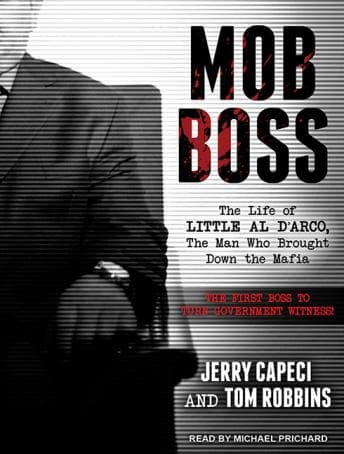

I was three hours into a logo redesign at 2 AM, Diego purring on my lap like a little motor, when Michael Prichard's voice made me set down my stylus and just... sit there. He was describing the moment Al D'Arco realizes the men he's killed for, bled for, lied for—they're planning to kill him. And Prichard delivers it with this quiet devastation that made my apartment feel smaller. Colder.
Look, I'm a romance girl. True crime isn't my usual territory. But my tío Carlos has been obsessed with mob history since forever, and when he recommended this one, I figured I'd give it a shot. Abuela would have clutched her rosary through every chapter and then asked me to tell her what happened next.
When Loyalty Becomes a Death Sentence
This book felt like watching someone slowly realize they've been standing on a trapdoor the whole time. Alfonso "Little Al" D'Arco spent four decades in the Luchese crime family, working his way up from Brooklyn street kid to acting boss. And then in 1991, he became the highest-ranking mobster to ever flip.
The authors—Jerry Capeci and Tom Robbins, both mob beat reporters—spent hundreds of hours interviewing D'Arco, and you can feel that intimacy. This isn't secondhand gossip. This is the man himself, explaining how a famous pizza parlor doubled as a heroin distribution center, how hit men dressed as women to carry out murders, how the mob kidnapped a newsman's son over a satirical novel.
The emotional core here isn't action—it's isolation. Prichard captures this thing where you feel the other guys turning their backs on you, freezing you out. That slow-motion betrayal. By the time D'Arco makes his decision to flip, you understand it's not about courage or cowardice. It's survival math.
The Tangent Problem (And Why I Didn't Hate It)
Okay, real talk: this book wanders. At 16 hours, there are stretches where D'Arco's story takes a backseat to mob history lessons about players you've never heard of. Some listeners find this tedious, and I get it. Around hour 8, I was designing a wedding invitation suite and had to rewind twice because I'd zoned out during a tangent about some 1970s Gambino situation.
But here's the thing—those tangents are also what makes this feel like sitting with your tío at the kitchen table while he connects every cousin and second cousin in the old neighborhood. It's not efficient storytelling. It's oral history. And when you're in the right headspace for it, there's something almost cozy about the sprawl.
Prichard's Voice Is Made for This
Michael Prichard doesn't do flashy. He's not giving you different voices for every wiseguy—this is standard single-narrator delivery. But what he does is create atmosphere. His tone carries this weight, this inevitability. When the walls start closing in on D'Arco, Prichard's pacing shifts just enough that you feel the noose tightening. It's subtle work, the kind that serves the material rather than showing off.
I listened at 1.0x because rushing this felt wrong. The tension builds through accumulation, not speed. Let it breathe.
Who This Is For (And Who Should Skip)
If you want a tight, propulsive thriller, this isn't it. Skip it if you need constant momentum or can't handle 16 hours of sprawling mob genealogy. But if you want to understand how a man spends forty years in organized crime and walks away with his life, how loyalty curdles into paranoia, how the mob actually functioned as a business and a death cult simultaneously—this is your book.
My tío Carlos was right. This is the kind of history that doesn't make it into textbooks, told by someone who lived it and somehow survived.
Miss You, Abuela
I didn't expect to feel things about a man who ordered hits. But there's this moment—and I won't spoil exactly when—where D'Arco talks about what he lost. Not the power, not the money. The identity. The belonging. That same quiet devastation about identity unraveling hit me hard in Silent Patient, though the secrets there were buried much deeper. And I sat in my dark apartment with my cats and thought about my abuela, who always said the saddest thing in the world is a man with no home to go back to.
She would have watched this like a telenovela. She would have shaken her head and said "Ay, mijo" at all the right moments.
Miss you, Abuela.