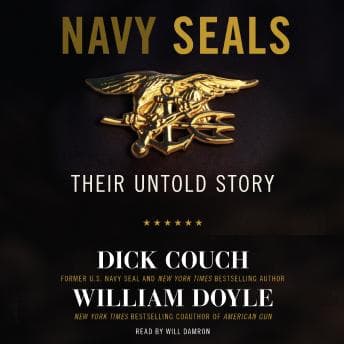

I was up at 0430 last Tuesday - old habits die hard - sitting on the back porch with Ranger and a thermos of black coffee while Austin was still dark and quiet. Started this one because I'd been meaning to get to it for months, and something about the pre-dawn silence felt right for a book about men who do their best work in the dark.
Let me cut to the chase: Dick Couch and William Doyle put together the most thorough institutional history of Naval Special Warfare I've come across in audio form. This isn't a rah-rah recruitment video. It's a serious, chronological account that starts where most people don't - the Naval Combat Demolition Units clearing beach obstacles at Normandy and the Underwater Demolition Teams in the Pacific - and works forward through Vietnam, the post-Cold War wilderness years, and the post-9/11 era where SEALs became household names.
The Author Clearly Did Their Homework (Because One of Them Lived It)
Couch is a former SEAL and Vietnam vet, and you can feel that throughout. The book draws from over 100 interviews with operators, including multiple Medal of Honor recipients, and the level of operational detail reflects someone who knows the difference between what sounds cool and what actually happened. The WWII sections alone are worth the listen - the UDT swimmers at Kwajalein and Saipan, working naked with nothing but swim trunks, a knife, and a slate to chart obstacles. That's not Hollywood. That's documented history that most Americans have never heard. The same commitment to getting the big picture right - not just the dramatic moments but the full sweep of a conflict - is what made Second World Wars: How the First Global Conflict Was Fought and Won stick with me too.
What I appreciated most is the book's honesty about the growing pains. The transition from UDT to SEAL Teams in 1962 wasn't some smooth, destined-to-be-great origin story. It was messy. Bureaucratic. The early Vietnam deployments were essentially the Teams figuring out their doctrine in real time, which - I've seen this scenario play out in real life - is how most military innovation actually works. You don't get a manual from the Pentagon. You get dropped into the Mekong Delta and figure it out.
The post-Vietnam decline gets proper attention too, when the community shrank and struggled for relevance. Most SEAL books skip right to the glory days. This one doesn't flinch from the lean years.
Will Damron Behind the Mic
Damron's narration is clean and professional. Straightforward delivery, no dramatic vocal gymnastics, which is exactly what military nonfiction needs. He doesn't try to "perform" the interview quotes or put on operator voices - he just reads them clearly and lets the words carry the weight. At 1.25x he moves at a solid clip without losing any clarity.
That said, he's reading someone else's war. You can tell. There's a flatness to some of the more intense operational passages - the Grenada missions, the early Afghanistan cave complexes - where a narrator with personal military experience might have found a different gear. It's not a knock, exactly. He's competent and easy to listen to for nine-plus hours. But there were moments where I wanted the delivery to match the gravity of what was being described, and it stayed at the same measured tempo.
Where It Lost Me (A Little)
The book's biggest weakness is structural. Because it's comprehensive and chronological, some sections feel like a textbook march through operations - this happened, then this happened, then this. The WWII and Vietnam chapters have real narrative energy because the authors had time to develop characters and scenarios. But as the book accelerates through the 80s, 90s, and into the GWOT era, it starts to feel like a highlight reel. The bin Laden raid gets coverage, obviously, but by that point you're getting summary treatment of operations that could fill their own books.
Also - and this is minor but it bugged me - the book was published in 2014, so the post-9/11 coverage already feels dated. A decade of operations have happened since. That's not the authors' fault, but it's worth knowing you're not getting the full picture of modern NSW.
Who Should Saddle Up (And Who Should Stand Down)
If you're a military history reader who wants the real institutional story behind the trident - not the Chris Kyle version, not the Marcus Luttrell version, but the 70-year organizational history - this is your book. It's the kind of thing I'd hand to a young officer who wants to understand how special operations communities actually evolve.
If you're looking for a single-operator memoir with constant action and personal stakes, this isn't that. It's bigger than any one man, which is both its strength and its limitation. You'll learn a lot, but you won't get your heart rate up.
Worth your time? Here's the debrief: solid history, competent narration, genuine insider access. Not perfect, but the real deal. Ranger slept through most of it, but he does that with anything that doesn't involve treat bags crinkling.







![Steve Jobs [unabridged audiobook] audiobook cover](/_next/image?url=https%3A%2F%2Fcovers.audiobooks.com%2Fimages%2Fcovers%2Ffull%2F9788499923406.jpg&w=1920&q=75)