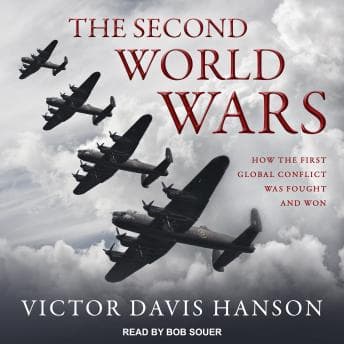

Victor Davis Hanson wrote one of the most intellectually rigorous analyses of World War II I've encountered, and the audiobook format nearly kneecaps it. For a more personal look at the human cost of war, Sergeant York and His People delivers the kind of ground-level perspective Hanson's strategic analysis necessarily omits.
I finished this 23-hour beast during a week of long drives between client sites across Texas. Ranger was riding shotgun for most of it, and even he seemed to zone out during some stretches—though that might've been the monotone delivery more than the subject matter.
The Strategic Brilliance You Came For
Hanson's central thesis is elegant and, frankly, obvious once he lays it out: the Axis powers were configured to win quick, limited wars. The moment they stumbled into a global conflict against industrial democracies with massive resource bases, they'd already lost. They just didn't know it yet.
What separates this from your standard WWII history is the thematic approach. Hanson doesn't march chronologically from Poland to VJ Day. Instead, he dissects the war by domain—air power, naval warfare, infantry combat, industrial capacity, leadership decisions. You get chapters comparing the effectiveness of strategic bombing across all theaters, or analyzing why certain tanks dominated while others became coffins.
For someone who's studied military operations professionally, this is gold. Hanson draws on 3,000 years of military history to contextualize everything. When he discusses the failure of the Luftwaffe to achieve air superiority over Britain, he's connecting it to principles that would've been familiar to Sun Tzu. That same depth of historical context shows up in Noble Woman: The Life-Story of Edith Cavell, though focused on the moral courage required during WWI rather than tactical doctrine. The man knows his craft.
Where the Audio Format Fights You
Here's my problem. Hanson writes like a classics professor—because he is one. Dense paragraphs packed with statistics, comparative analyses, and references that would benefit enormously from being able to flip back three pages and check a number. In print, you'd have footnotes, maps, charts. In audio, you have Bob Souer reading numbers at you while you're trying not to miss your exit.
Souer's delivery is... serviceable. Clear enunciation, no pronunciation disasters that made me cringe (and believe me, I've heard narrators butcher military terminology badly enough to make me pull over). But the man reads like he's narrating a technical manual. Which, in fairness, this kind of is. The content demands engagement; the narration doesn't help provide it.
I bumped it to 1.25x—my standard—and found it helped somewhat. At normal speed, I was losing focus during the more data-heavy sections. Faster pace kept my brain engaged, though I still found myself rewinding when Hanson rattled off production statistics for American versus German tank manufacturing.
Who Should Engage (And Who Should Stand Down)
If you're a casual WWII enthusiast who wants dramatic storytelling about individual battles, this isn't your book. Hanson assumes you already know the basic narrative. He's not explaining what happened at Stalingrad; he's analyzing why the German logistics system made that outcome inevitable.
This is for the reader who's already consumed the standard histories and wants to understand the war at a systems level. Why did Allied strategic bombing fail to collapse German morale but succeed in destroying their fuel production? Why did Japan's carrier doctrine work brilliantly at Pearl Harbor but catastrophically at Midway? Hanson has answers, and they're backed by serious scholarship.
Military professionals, serious history buffs, anyone who wants to understand modern strategic thinking—worth your time. Someone looking for Band of Brothers in audio form? You'll be asleep by hour three.
After-Action Report
I've seen this scenario play out in real life: brilliant analysis delivered in a format that works against it. The content here is genuinely outstanding. Hanson's reframing of WWII as multiple interconnected conflicts rather than one linear narrative changed how I think about the war, and I've been studying this stuff for decades.
But 23 hours of dense historical analysis with a narrator who sounds like he's reading his taxes? That's a commitment. I'd almost recommend the print version for first read, then audio for review. The information density is just brutal in pure audio format.
If you're serious about military history and willing to work for it, absolutely worth your time. If you want something you can half-listen to during workouts, hard pass. This demands your full attention, and even then, you'll probably want a notepad.
Ranger approved this one—but he's a German Shepherd with infinite patience. Your mileage may vary.





![Steve Jobs [unabridged audiobook] audiobook cover](/_next/image?url=https%3A%2F%2Fcovers.audiobooks.com%2Fimages%2Fcovers%2Ffull%2F9788499923406.jpg&w=1920&q=75)