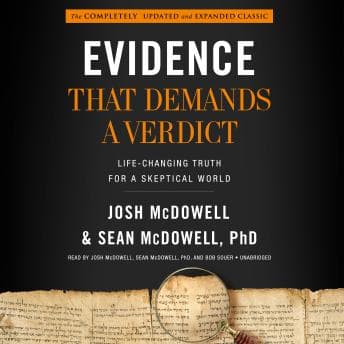

Forty-two hours and forty-four minutes. Let me say that again. Forty-two hours. That's longer than the entire audiobook of War and Peace on most platforms. I checked. And look — I teach teenagers who think a three-page essay is cruel and unusual punishment, so I'm not one to complain about length for its own sake. But when I hit hour sixteen of Evidence That Demands a Verdict somewhere on the lakefront path near Montrose Harbor, with Denise walking ahead of me because I'd stopped dead to process a particularly dense section on manuscript reliability, I had to ask myself: is this book meant to be listened to, or is it a reference encyclopedia that someone accidentally narrated?
The answer, it turns out, is kind of both. And that's the fundamental tension of this audiobook.
A Textbook That Doesn't Know It's a Textbook
Here's what the McDowells have built: a comprehensive apologetics reference covering biblical historicity, the resurrection accounts, prophetic fulfillment, responses to modern criticism — basically every question a skeptical college freshman might throw at you in a dorm room at 2 AM. And as a reference work? It's genuinely impressive. The updated edition tackles newer critics and contemporary scholarship that the original 1972 version couldn't have anticipated. The chapter addressing the so-called "gospel contradictions" lays out parallel manuscript evidence with the kind of methodical patience I wish my students would bring to a close reading of anything.
But — and this is a significant but — this book was designed to be flipped through. Dog-eared. Returned to. It's structured like an academic resource with numbered arguments and sub-points and citations stacked on citations. Translating that into a linear audio experience is like trying to listen to a dictionary from A to Z. You can do it. I did it. But your brain starts treating the information like background noise somewhere around the twelfth hour of textual criticism evidence.
This reminds me of what Hemingway said about prose being architecture, not interior decoration. The McDowells have built a cathedral here, but cathedrals aren't meant to be experienced by walking through every single room in a single afternoon.
Bob Souer and the Marathon of Monotone
Bob Souer has a clear, professional voice — the kind of narrator you'd want reading corporate training materials, and I don't mean that as an insult. For the first several hours, his measured, even tone actually works well. He handles the shift between the McDowells' more personal anecdotes and the denser academic argumentation without stumbling. The production quality is clean. No weird audio artifacts, no inconsistent levels.
But here's the problem: forty-two hours of a single narrator reading what is essentially a scholarly argument requires vocal variation that Souer doesn't quite deliver. By the middle third, his pacing settles into a rhythm that's so consistent it becomes hypnotic — and not in the good way. I caught myself rewinding multiple times during late-night grading sessions because I'd drifted. The narrator understands that pause is punctuation, but he doesn't use enough of them. The sections where the McDowells address personal stories about doubt and faith needed a warmer, more conversational register, and Souer stays in lecture mode throughout. It's competent. It's professional. It's also kind of relentless.
(My students would call this "giving NPC energy." I hate that I know what that means.)
Who This Is Actually For — And Who Should Run
If you're a pastor, seminary student, or small group leader who wants a comprehensive audio reference you can dip in and out of — specific chapters on specific topics — this is genuinely useful. The chapter on the historical reliability of the New Testament documents alone is worth the investment for anyone doing serious study. And the bonus content on science and faith is a nice addition that feels more conversational than the main text.
But if you're a casual listener looking for something like Timothy Keller's The Reason for God or C.S. Lewis's Mere Christianity — books that make the same kinds of arguments with literary grace and personal warmth — you will hit a wall with this one. Those books were written to be read (or listened to) straight through. This one was written to be consulted.
If you loved Mere Christianity, this is its spiritual successor — but in the way that an encyclopedia is the spiritual successor to an essay. Same neighborhood, very different house. The same gap between reverent documentation and readable narrative is what made me struggle with Story of Joan of Arc — another book where the subject matter is genuinely extraordinary but the presentation keeps you at arm's length, like you're reading a dossier about someone instead of meeting them.
The Annotation in My Margins
I respect what the McDowells have done here. Twenty years of watching teenagers ask hard questions about faith and meaning has taught me that having rigorous answers matters, even if the packaging isn't always elegant. The prose deserves to be savored — in sections, with a notebook, not in a forty-two hour marathon while your wife wonders why you've been mumbling about Dead Sea Scroll dating on your evening walk.
Worth pausing the faculty meeting for? Specific chapters, absolutely. The whole thing in one go? Principal Martinez's budget presentation might actually win that round.