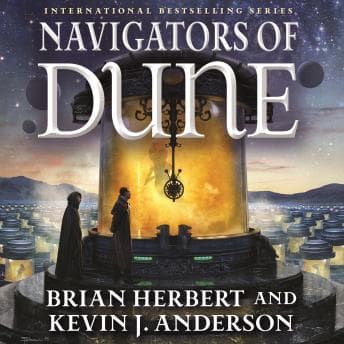

I was supposed to be debugging a procedural terrain generator at 2 AM. Instead, I was eight hours deep into Navigators of Dune, watching the proto-Spacing Guild figure out that folding space might actually be a thing humans can do. My thesis advisor would be disappointed. I am not.
Look, the Herbert-Anderson Dune books get way more hate than they deserve. Yes, I can already hear the purists sharpening their crysknives. But after 18 hours with this finale playing through my headphones while I absolutely did not work on my thesis, I'm ready to defend it. The thing that bugs me about the criticism is that people want these prequels to BE Frank Herbert. They're not. They're never going to be. But what Brian Herbert and Kevin J. Anderson do really well is the connective tissue—showing you how all these pieces that exist 10,000 years later actually got put into place.
The Origin Story Your Lore-Brain Craves
This is Sanderson-level world-building, honestly. The magic system here—and yes, prescience and spice-navigation count as a magic system, fight me—gets the origin story treatment it deserves. There's something deeply satisfying about watching Norma Cenva's Navigator descendants start to understand what they're becoming. The progression hits that sweet spot where you're nodding along going "oh, THAT'S why they're in those tanks."
The three-way dance between the Sisterhood, the Mentats, and the Navigators is where the book really shines. Each faction is trying to establish legitimacy in a post-Butlerian Jihad galaxy that's still twitchy about anything that smells like machine-thinking. The philosophical debates about what constitutes "human" calculation versus forbidden computation? My D&D group would love this. It's the kind of lore-heavy political maneuvering that rewards paying attention—like watching three players all trying to become the party face while secretly plotting against each other.
The Pacing Hits a Sandworm-Sized Speed Bump
Okay, so here's where I have to be honest—some stretches in the middle feel like filler. The Gilbertus storyline wraps up in a way that's... competent? It ties the threads together without that gut-punch moment you might want from a trilogy closer. The battle scenes between the extreme factions have weight, but the sections between them sometimes drag.
Here's the thing though—this is a prequel. We KNOW where it's going. The tension isn't "will humanity survive" because we know humanity survives for another 10,000 years until Paul Atreides shows up. The tension is in the HOW. How do these institutions become what they become? How does reason beat fanaticism without becoming fanatical itself? That's the story being told, and it does tell it. Just... sometimes at a slower pace than I wanted when I was trying to justify "one more chapter" at 3 AM.
Scott Brick Has Been Living in This Universe
I've listened to enough fantasy and sci-fi narrators to know when someone's phoning it in versus when they actually understand the material. Brick falls firmly in the second camp. The man won an Audie for Butlerian Jihad back in 2003, and you can hear why—he's been inhabiting this universe for over a decade. His range is genuinely impressive across genres too—I went down a rabbit hole and ended up at his narration of Squeeze Me, which is about as tonally opposite from Dune as you can get, and he's still completely locked in.
What I appreciate most is his restraint. He's not doing wildly different accents for every character like some narrators who think more voices equals better performance. Instead, he shifts tone and cadence in ways that feel organic to the Dune universe. The Bene Gesserit characters have this measured, calculating quality. The Butlerian fanatics get an edge of fervor without tipping into cartoon villain territory. It's the kind of performance where you stop noticing the narrator and just... exist in the story. Which, when you're tracking political machinations across three major factions, is exactly what you need.
His pacing makes 18 hours feel manageable. I knocked this out over a week of coding sessions and walks around campus when I should've been in the library. The miles floated by. The thesis did not write itself.
Who Should Strap In (And Who Should Eject)
If you don't like info-dumps, this isn't for you (but you're wrong). This is dense, lore-heavy science fiction that rewards investment in the broader Dune universe. If you've read the original six Frank Herbert novels and want to understand the deep history—how the Sisterhood's breeding program started, why the Navigators are the way they are, what the Mentats had to prove to survive—this trilogy delivers that context.
If you're looking for the poetic density of Frank Herbert's prose, you'll be disappointed. The writing style is more accessible, more plot-focused. That's a feature for some readers and a bug for others. Know which camp you're in before you commit.
Skip this if: you haven't read at least the first Dune book (you'll be lost), you hate political intrigue, or you need constant action to stay engaged.
Worth Rolling Your Character Sheet For
Yes, it's 18 hours. Yes, the whole trilogy is closer to 50. Yes, it's worth it if you're the kind of person who reads wiki articles about fictional history. The Schools of Dune is genuinely the best Dune-adjacent work since Frank Herbert's original series, and this finale—despite some pacing wobbles—sticks the landing on what matters: showing you how the pieces got on the board before the game even started. The three-way faction chess reminds me of the same sprawling political architecture in Thrawn Ascendancy: Lesser Evil—different universe, same itch scratched, and another book I absolutely should not have started the night before a deadline.
I read this instead of writing my thesis and I regret nothing. Dr. Patel can wait. The spice must flow.