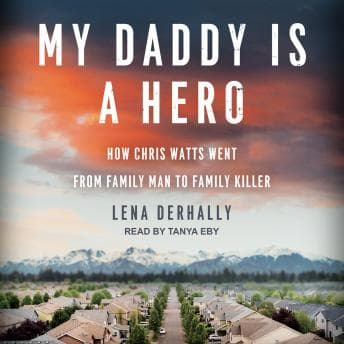

People keep telling me I should listen to this because I "work in healthcare and understand pathology." As if understanding cluster B personality disorders requires a trauma nurse badge. But fine - I gave it a shot on a rare day off, folding laundry while the kids were at school and Carlos was running errands. And look, I have complicated feelings about this one.
Derhally is a psychotherapist, and she approaches the Watts case the way a clinician would - attachment theory, Imago relationship dynamics, subtypes of narcissism. I respect the framework. I really do. As someone who's actually worked a code on patients whose partners "didn't know what happened," I appreciate when someone tries to build a clinical profile instead of just sensationalizing the gore. And the sections on community psychopaths - the ones who blend in, who coach Little League, who bring donuts to the office - those hit differently when you've watched families fall apart in trauma bays and thought, "How did nobody see this coming?"
The Therapist's Couch Approach Has Limits
Here's where I got frustrated enough to talk to my laundry basket. Derhally lays out a solid theoretical foundation. She interviews a neuroscientist, a criminal psychologist, a journalist. She walks through Shanann and Chris's childhoods, their families of origin, how they met. All good building blocks. But when it comes to the actual "why" - the thing the subtitle promises - I kept waiting for a deeper excavation that never quite came. She circles the answer. She gestures at it. She gives you the clinical vocabulary for it. But there's this gap between the professional analysis and the raw, specific horror of what this man did to his pregnant wife and two little girls, and Derhally doesn't always bridge it.
Some of the relationship dynamics material felt like it could've come from a general psychology textbook. The sections on Shanann's social media presence and how it intersected with Chris's need for control - that was specific and sharp. The breakdown of his affair and the compartmentalization he maintained? Good stuff. But the book sometimes reads more like a clinical case study than the psychological deep dive the premise sets up. Mystery: An Alex Delaware Novel manages a similar clinical lens but with sharper narrative tension—Kellerman's psychologist protagonist bridges that gap between professional distance and the messy human cost in a way this book kept reaching for but not quite gripping. At eight hours and change, there's room for both. I wanted more of the specific and less of the general.
Tanya Eby Behind the Mic - Let's Talk About It
I've seen people complain that a female narrator shouldn't narrate a book about a male killer. I disagree with that on principle - gender of the narrator doesn't determine quality. But Tanya Eby's delivery here is... clinical in a way that matches the author's approach, which means it's measured and steady when the material sometimes needs more weight. She reads it competently. Clearly. Professionally. But there are moments - the descriptions of the children, the timeline of that night - where the narration feels like it's maintaining a professional distance that the material itself can't support. I had the opposite experience with Eby's work on I Know a Secret, where her measured delivery actually amplifies the creeping dread in a way that fits the genre better—here it just felt like a mismatch between tone and tragedy. You're hearing about Bella and Celeste, and the delivery stays at the same emotional register as the attachment theory explanations. That's a choice, and I understand it, but it didn't work for me.
I wasn't yelling at my dashboard on this one. I was just... quiet. Folding towels. Thinking about my own kids sleeping down the hall every night, trusting their dad completely. That silence hit harder than any narrator performance could have.
Who This Is Actually For
If you've consumed every documentary, every podcast episode, every Reddit deep dive on the Watts case, this gives you something different - a clinician's perspective, not a true crime entertainer's. That has value. The interviews with experts add legitimacy, and the warnings about recognizing these personality patterns in your own life are genuinely useful. My mom would love this - she watches every Dateline episode and then calls me to ask if the medical details were accurate. (She still thinks I should've been a doctor.)
But if you're coming to this expecting the definitive answer to "how does a man murder his own children," you'll walk away with frameworks and theories rather than that gut-punch understanding. Maybe that's the honest answer - maybe there IS no satisfying "why" for something like this. But the book promises one and doesn't fully deliver.
Night Shift Prescription
This is not how you decompress after a rough shift. Save this for a day off when you have emotional bandwidth. It's informative, it's clinical, it's occasionally powerful - but it left me with more questions than it answered, and at a certain point, the psychology textbook tone started to flatten the very human tragedy underneath. Worth streaming through your library app on a quiet afternoon. Spending a credit? I'd hold that for something that sticks the landing harder.