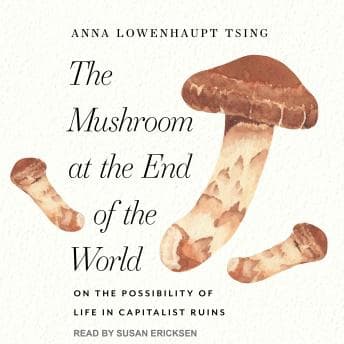

So it's 11:30 PM on a Tuesday, I just got paged for a cascading failure in our storage layer, fixed it in 40 minutes (personal record), and now I'm too wired to sleep. Perfect time to finish the last two hours of a book about mushrooms and the collapse of industrial capitalism. As one does.
I picked up The Mushroom at the End of the World because someone on our team's Slack channel posted a quote about how matsutake mushrooms only grow in ruined forests, and my first thought was "that's basically distributed systems resilience but for ecology." And honestly? That comparison held up way better than I expected.
This Is Basically a Postmortem for Industrial Capitalism
Anna Tsing is an anthropologist, and this book reads like the most ambitious root cause analysis you've ever seen - except instead of tracing a production incident through microservices, she's tracing a single mushroom through global supply chains, refugee communities, Japanese gift economies, and the wreckage of Oregon's timber industry. The matsutake mushroom can't be farmed. It only grows in forests that have been disturbed - logged, burned, abandoned. And it's worth hundreds of dollars per pound in Japan.
So Tsing follows the matsutake from the forest floor where Hmong, Lao, and other marginalized pickers harvest it in the Pacific Northwest, through a bizarre open-air auction system in the woods, across the Pacific to Japanese markets where it functions as a prestige gift, and back out into the philosophical question of what "progress" even means when we've trashed the planet.
The thing that surprised me most is how weird the economics are. She describes these mushroom camps in Oregon where the pickers are mostly Southeast Asian veterans and immigrants, and the buying system is basically a decentralized market with no fixed prices - buyers drive trucks into the forest and bid in real time. It's like a spot market operating out of pickup trucks. There's no employer-employee relationship, no supply chain management. It's capitalism at its most feral and unstructured, and Tsing argues that this is actually more representative of how global trade works than the neat org charts we imagine.
The Pacing Problem (and How to Fix It)
Okay, here's where I have to be honest. I bumped this up to 1.75x by hour three. Susan Ericksen's narration is careful and precise - she handles the Japanese terms, the Hmong names, the Finnish and Chinese references without stumbling, which is genuinely impressive for a book that covers this many languages and cultures. But the default pacing is academic-lecture-at-3PM slow. Like, "professor who knows the material is fascinating but hasn't calibrated for an audience that might drift" slow.
At 1.75x, Ericksen sounds like a really engaged NPR host, which is exactly the energy this book needs. The prose itself is actually quite beautiful in spots - Tsing has this way of zooming from a microscopic fungal network to global capitalism in a single paragraph - but the narration at 1x doesn't match that intellectual energy. It flattens the excitement.
This is a book that requires your brain to be ON. I tried listening during my morning commute and found myself zoning out somewhere between Hmong veterans' experiences in the Oregon woods and the biology of mycorrhizal networks. Not because the content was boring - it's genuinely fascinating stuff - but because Tsing structures the book like a mushroom network itself. Non-linear. Chapters that feel like independent essays. No single narrative throughline pulling you forward. It's designed that way on purpose (she literally calls the chapters "tracks" as in animal tracks, not sequential chapters), but on a packed Caltrain at 6 AM, that design philosophy is fighting you.
Who This Is Actually For
If you liked Braiding Sweetgrass but wanted more economic analysis and less memoir, this is your book. The Tipping Point scratches a similar itch if you want that same "small thing, massive systemic consequence" energy with a tighter narrative spine. If you're the kind of person who reads Hacker News threads about supply chain fragility and thinks "but what about the philosophical implications" - hi, welcome, you're home.
Skip this if you need a strong narrative arc or if your audiobook time is exclusively low-attention contexts like gym or housework. This one punishes you for drifting. I lost a whole chapter somewhere around the Yi Chinese goat herder section because Kevin texted me about dinner plans and by the time I looked up (metaphorically), Tsing was talking about spore dispersal patterns.
But here's the thing - the ideas in this book have been rattling around my head for weeks. The concept that precarity isn't a bug but a feature of late capitalism. That the most interesting ecological and economic activity happens in the margins, in the ruins, in the systems that weren't designed. As someone who spends her days working on systems that were designed and still fall apart, there's something deeply satisfying about a book that says: yeah, the planned economy of nature is over. Let's look at what grows in the wreckage.
The ROI on this audiobook is high but back-loaded. You won't feel it during the listen. You'll feel it three weeks later when you're debugging something and suddenly thinking about mushroom supply chains.
Commit to Main, but Maybe Not on the Train
Perfect for: dedicated weekend listening, a long flight, a Sunday where you actually want to think. Skip for: the 6 AM commute, background listening, anything where you can't give it 70%+ attention. I'd say read the physical book if you're a fast reader, but if audio is your medium, crank the speed and lean in. It rewards the effort.








![Steve Jobs [unabridged audiobook] audiobook cover](/_next/image?url=https%3A%2F%2Fcovers.audiobooks.com%2Fimages%2Fcovers%2Ffull%2F9788499923406.jpg&w=1920&q=75)