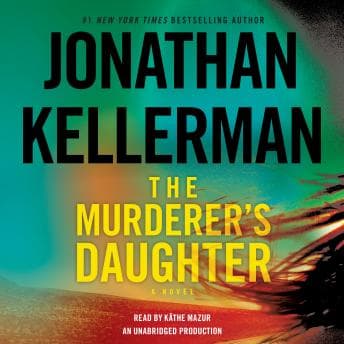

People keep calling this Kellerman's big departure from Alex Delaware, and yeah, it is. But here's the thing nobody's warning you about: the first four hours are basically a clinical case study of childhood trauma. Not a thriller. A case study. And as someone who's spent fifteen years in a trauma center watching psych consults happen in real time - Kellerman actually nails it. The foster care shuffle, the way a genius-level kid learns to mask, the institutional indifference. I was sitting at my kitchen table at 8 AM, post-shift, too wired to sleep, and instead of my usual "fall asleep to something light" routine, I was just... listening. Fully locked in.
So that surprised me.
Grace Blades Is the Patient I'd Want to Talk To (and Also Avoid in a Dark Alley)
Grace is a psychologist with a body count's worth of secrets and an IQ that the book reminds you about roughly every twelve minutes. She witnessed her parents' murder-suicide at five, bounced through the system, got adopted by a loving couple, and clawed her way into professional respectability. But she has this whole other life - calculated, cold, dangerous - that Kellerman reveals in layers.
Here's where my professional brain kicks in. The psychological framework is solid. Kellerman's a clinical psychologist himself, and it shows. Grace's compartmentalization, her hypervigilance, the way she uses intellect as armor - that tracks. I've seen trauma survivors who function at extraordinarily high levels and carry darkness nobody suspects. The medical and psychological details are accurate. Finally. No magical therapy breakthroughs in a single session. No "I'm cured now" nonsense. When Grace refuses to take Andrew Toner as a patient after they recognize each other from a prior encounter, that's actual ethics. That's how it works. I didn't yell at my dashboard once about the clinical stuff.
But - and this is a big but - Kellerman gets so deep into Grace's backstory that the actual thriller plot doesn't really ignite until you're well past the halfway mark. Fourteen hours is a lot of audiobook. And there were stretches, particularly the middle sections cataloging Grace's academic achievements and romantic history, where I caught myself checking how much time was left. You don't want to be doing that math at 7 AM when you're already fighting to stay awake.
Kathe Mazur Does the Heavy Lifting
Kathe Mazur's narration is the glue holding this together during those slower stretches. She reads Grace with this controlled, clinical precision that fits the character perfectly - there's a flatness to her emotional delivery that isn't bad performance, it's characterization. Grace would sound like that. Measured. Guarded. When the tension finally ratchets up in the final third, Mazur shifts gears and you feel the difference in your chest.
I don't have enough to say she does wildly distinct voices for every character - there are a LOT of characters in this book, and keeping track of who's who without a physical page to flip back to got genuinely annoying at times. A few of the secondary male characters blurred together vocally. But Grace's internal voice? Mazur owns that completely.
The production is clean. No weird audio artifacts, no volume inconsistencies. Solid work on the technical side.
The Thriller That Takes Its Sweet Time Becoming a Thriller
Look, if you're coming from the Alex Delaware series expecting that tight procedural pacing, pump the brakes. This is a character study that eventually becomes a cat-and-mouse thriller. The murder investigation, the manipulative antagonist, the convergence of Grace's two lives - it all pays off. Nowhere to Run gave me that same slow-burn payoff feeling - the kind where you're not sure the pieces are going to come together and then suddenly they absolutely do. The last four or five hours genuinely had me gripping the steering wheel on my drive home. But you have to earn those hours. You have to sit through what feels like a very thorough psych intake assessment first.
Is that a flaw? Depends on what you want. I actually appreciated the depth because Kellerman isn't faking the psychology. He's building a real person. But I also recognize that "this detailed backstory will pay off eventually, trust me" is a hard sell at 3 AM when you're charting and your eyelids are staging a protest.
The ending is satisfying. Not perfect - Grace makes a couple of choices that felt more plot-convenient than character-consistent - but satisfying. My mom would love this. She's always saying I should read more books by doctors. (Close enough, Ma.)
Who Gets the Prescription and Who Doesn't
This is for people who want their thriller with a psychology degree attached. If you like Robin Cook but wish he'd slow down and actually explore his characters' inner lives, Grace Blades is your girl. If you need action by chapter three, you're going to get restless.
Not a night shift listen. Too slow in the middle for tired brains. Perfect for that post-shift decompression when you're awake enough to pay attention but need something absorbing to keep the work memories from creeping in. I'd bump it to 1.25x speed through the middle sections - Mazur's pacing can handle it.
Carlos asked why I looked so intense making breakfast. I told him I was thinking about childhood trauma and murder. He just handed me more coffee. Fifteen years married to a night shift nurse - the man knows not to ask follow-up questions.