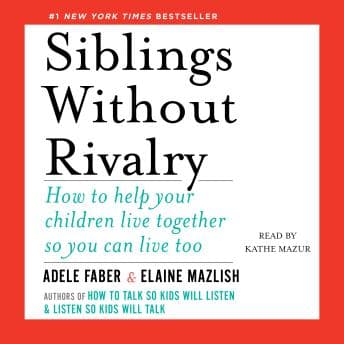

"Stop treating them the same. Start treating them uniquely." That line hit me somewhere around hour two, stuck in traffic on 101 because Caltrain was doing weekend maintenance. And I just sat there thinking about my own childhood - my brother and I fighting over everything from the TV remote to who got the bigger piece of cake.
Look, I don't have kids. But I have a sister-in-law who texts me parenting book recommendations like she's trying to convert me to a religion, and when she mentioned this one for the third time, I figured I'd give it a shot. Six hours isn't a huge commitment, and honestly? I get why she kept pushing it.
The Framework That Actually Makes Sense
Faber and Mazlish basically reverse-engineer sibling conflict. Their core thesis: most of the well-meaning things parents do to "be fair" actually make rivalry worse. Treating kids identically? Backfires. Comparing them, even positively? Backfires. Playing judge when they fight? You guessed it.
The book is structured around these parent workshop sessions - real scenarios, real dialogue, real solutions. It's not abstract theory. It's "your kid just hit their sibling with a toy truck, here's what you say in the next 30 seconds." As someone who debugs systems for a living, I appreciate that level of specificity. Give me the exact input-output, not vague principles. That same clarity shows up in Leaders Eat Last, where Sinek breaks down team dynamics with actual neuroscience instead of corporate platitudes.
The ROI on this audiobook is pretty clear if you're dealing with sibling chaos. The strategies are actionable. Like, immediately actionable. My sister-in-law tried the "describe what you see instead of taking sides" technique the day after I told her about it, and apparently it actually... worked? Her kids were confused, which she took as a win.
Where Kathe Mazur Nails It (And Where She Doesn't)
Mazur has this warm, clear delivery that works perfectly for parenting content. She's won Audies, she's got the credentials. And her pacing is solid - not rushed, not dragging. Perfect for absorbing advice while you're half-focused on not missing your stop.
But here's the thing. The book itself uses this pseudo-narrative format with dialogue examples, and after a while, it starts to feel a bit... repetitive? Mazur does her best, but there's only so much you can do when the source material keeps cycling through similar scenarios. By chapter four, I was bumping up to 1.5x just to keep things moving.
It's not her fault. The writing style is what it is. Some listeners find it engaging, some find it grating. I landed somewhere in the middle - appreciated the examples, got a little tired of the format.
The Pseudo-Narrative Problem
Okay, so. The authors include these fictional parent dialogues throughout the book. "Parent A says this, Parent B responds with that." It's meant to feel relatable. And sometimes it works! You hear a scenario and think, "Oh god, that's exactly what happens."
But sometimes it reads like a parenting manual cosplaying as a novel. The dialogue can feel stilted. The scenarios, while useful, start blending together. I found myself zoning out during some of the longer examples, then snapping back when they got to the actual advice. Untroubled Mind had a similar issue for me—useful content buried under a delivery style that occasionally tested my patience.
If you're sensitive to didactic writing styles, heads up. This might test your patience. I finished it in about four commutes, but I won't pretend every minute was riveting.
Who This Is Actually For
Perfect for: parents actively dealing with sibling conflict who need practical scripts. Also solid for expectant parents of kid #2 who want to get ahead of the problem. The strategies are based on decades of workshop experience, and it shows.
Skip if: you're looking for something narrative-driven or you get annoyed by repetitive structures. Also maybe skip if you're childless like me and don't have a compelling reason to care about sibling dynamics. (I cared because I'm nosy about family psychology, but that's a me thing.)
The production quality is clean - no weird audio glitches, no background noise. Standard professional audiobook. Nothing fancy, nothing broken.
Would I Recommend It?
For the right listener? Absolutely. This is basically a debugging manual for sibling relationships. If your home life involves kids screaming at each other over who got more screen time, this book gives you actual tools. Not platitudes. Tools.
For everyone else? It's a solid listen, but maybe not essential. I'm glad I heard it - gave me some insight into my own childhood dynamics, honestly - but I wouldn't call it a must-listen unless you're actively in the parenting trenches.
Kathe Mazur delivers a warm, accessible performance. The content is genuinely helpful. The format is the weak link, but it's not a dealbreaker. At six hours, it's a reasonable investment for anyone who needs it.