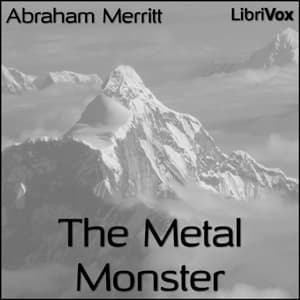

Everyone told me Abraham Merritt was this forgotten master of early fantasy, that The Metal Monster was a visionary work decades ahead of its time. And honestly? They weren't wrong. But also—and I need to be upfront here—this is a weird listen that requires some serious patience.
I started this at 5:47 AM on a Tuesday, half-dead on the Caltrain, and within twenty minutes I was genuinely confused about whether I was still awake. Not because it's boring—it's actually the opposite problem. Midnight Library had that same disorienting quality, reality bending in ways that demand your full attention. Merritt's prose is so dense, so hallucinatory, that following it while surrounded by commuters checking their Slack notifications felt like trying to debug a race condition while someone plays theremin in your ear.
When Sci-Fi Was Still Weird and Unashamed
Quick Verdict: This is basically Annihilation but for 1920. Dr. Goodwin and friends stumble into a Himalayan valley where sentient geometric metal shapes—cubes, spheres, tetrahedrons—form a living city governed by something called the Metal Emperor. These Things (Merritt capitalizes it, so I will too) can merge into colossal forms, wield death rays, and operate on logic that's genuinely alien.
What impressed me is that Merritt doesn't try to make the metal folk relatable. Their intelligence is completely non-human, and he commits to that. When the titanic battle between the Metal Monster and the lost Persian army happens, it's not framed as good vs. evil—it's more like watching an immune response. The metal entities don't hate the humans. They just... process them. That concept holds up remarkably well for something written over a century ago.
The hallucinatory cataclysm at the novel's end is genuinely wild. I finished it during a delayed train at Millbrae, standing in the vestibule because all seats were taken, and I just stared out the window for a solid minute afterward trying to process what I'd just heard.
The Various Readers Problem
Okay, here's where I have to be honest about the audio production. "Various Readers" is LibriVox code for "volunteer narrators of wildly varying quality." This is a free public domain recording, and you get what you pay for.
Some chapters have readers who clearly understand Merritt's ornate, almost hypnotic prose style and lean into it. Others sound like they're reading a grocery list. The transitions between narrators can be jarring—you'll get used to one voice's rhythm, and then suddenly it's someone else with completely different pacing and emphasis. For a book that already demands concentration, this adds another layer of difficulty.
I can't rate the narration as a cohesive performance because it isn't one. It's a patchwork. Some patches are silk, some are burlap.
The ROI Calculation
Here's my honest assessment: The Metal Monster is a legitimately important work of early science fiction that influenced everything from Lovecraft to modern "weird fiction." The concepts are ambitious, the alien perspective genuinely alien, and certain sequences—especially the exploration of the living metal city—are genuinely beautiful in their strangeness. Thief of Dreams also leans into that kind of beautiful strangeness, though with far less demanding prose.
But the audiobook experience is compromised. Merritt's prose is already challenging (lots of semicolons, lots of stacked adjectives, sentences that go on for days), and inconsistent narration makes it harder to sink into the rhythm. I found myself rewinding more than usual, especially during the denser descriptive passages.
Perfect for: Long flights, dedicated listening sessions where you can really focus. This is not a background book. Skip if: You need something for commute listening, unless you're one of those people who can concentrate through anything. (I am not those people at 6 AM.)
If you're a Merritt completist or seriously interested in the history of science fiction, this is worth your time. The ideas here—living metal, collective machine intelligence, humans as irrelevant to truly alien minds—were revolutionary in 1920 and still hit different today. But I'd almost recommend reading the text alongside listening, or at least keeping your playback speed flexible. I bounced between 1.0x and 1.25x depending on which narrator was up.
Worth the Archaeological Dig?
This is free on LibriVox, so the question isn't "is it worth a credit" but "is it worth 10 hours of your attention." For me, yes—with caveats. The Metal Monster is a fascinating artifact, a window into what science fiction could be before genre conventions calcified. It's genuinely imaginative in ways modern sci-fi often isn't.
But it's also work. The prose is dense, the narration is uneven, and you need to meet it halfway. I finished it in about 5 commutes plus one late-night insomnia session, and I'm glad I did. But I wouldn't recommend it to someone looking for easy entertainment.
The science doesn't hold up (it's 1920, they thought radium was basically magic), but the imagination absolutely does. Sometimes that's enough.