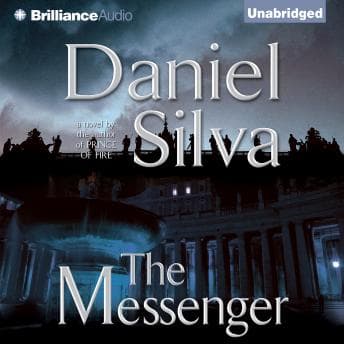

What happens when you put an art restorer in the middle of a counterterrorism operation and set the whole thing inside the Vatican? You get a protagonist whose motivations are genuinely fascinating to unpack - and a plot that knows exactly how paranoia works in enclosed, hierarchical institutions.
I was making chana masala at 10 PM on a Tuesday - the kind of elaborate cooking project my mother would approve of if she knew I was eating it alone over my laptop - when Christopher Lane's voice pulled me so deep into Gabriel Allon's world that I burned the cumin. Twice.
The Psychology of a Man Who Restores What He Destroys
The protagonist exhibits classic compartmentalization, and Daniel Silva actually gets this right. Gabriel Allon is an art restorer by trade and an intelligence operative by necessity, and what makes this character compelling is that Silva doesn't treat these as contradictions. They're two expressions of the same psychological impulse: control. Allon restores damaged paintings with meticulous precision. He dismantles terrorist networks with meticulous precision. The duality is almost Stevensonian - Strange Case of Jekyll and Hyde does something structurally similar with its framing of respectable profession versus hidden compulsion, and the dramatic reading makes that split-self tension viscerally audible in ways that kept me thinking about Allon for days. The research actually shows that people drawn to high-control professions often toggle between creative and destructive modes - it's how they regulate. Silva may not frame it in clinical terms, but the characterization tracks.
What I found myself asking: why does Allon keep getting pulled back? He's recovering from a previous operation, physically and psychologically depleted, and the moment intelligence surfaces about an al-Qaeda plot targeting the Vatican, he's on a plane to Rome. The book frames this as duty, loyalty to Monsignor Luigi Donati. But psychologically? This is a fascinating case study in trauma repetition. Allon doesn't know how to exist outside the crisis. The art restoration is the fantasy of a peaceful life. The espionage is who he actually is.
Now - some listeners have noted that Allon sounds older than his age in Lane's narration. And honestly? I think that works. The man has lived several lifetimes of grief and violence. If he sounded like a fresh-faced thirty-something, psychologically, this doesn't track.
The Vatican as a Character (and a Pretty Paranoid One)
Silva's real achievement here isn't the al-Qaeda plot - it's using the Vatican as a setting that functions almost like a psychological profile of institutional secrecy. The penetration of Vatican security isn't just a thriller device. It's an exploration of what happens when an organization built on absolute moral authority refuses to acknowledge its own vulnerabilities. The insiders, the art world figures, the clergy who orbit the pope - they all operate within systems of deference and silence that make them perfect targets.
This is where Lane's narration earns its keep. His handling of multiple accented English varieties - Vatican Italian, Israeli, British intelligence types - creates an audible map of allegiance and suspicion. You can hear the institutional hierarchies. His voice for Allon carries this weight, this careful restraint that breaks just slightly when things go sideways. It's a strong, sensitive read, and the pacing maintains a constant low-grade tension that had me stirring an empty pot for a solid five minutes without noticing.
The weaknesses? Look, if you've read previous Allon books, some of the narrative machinery will feel familiar. There are recycled structural beats - the reluctant return to duty, the duel of wits framing, the globe-trotting chase. Silva is working within his formula, and while the formula is effective, a few sections had me thinking "I've been here before." The ending especially felt rushed, like Silva spent careful hours building an intricate mechanism and then knocked the last few pieces into place with his elbow. My therapist would have thoughts about this character's inability to find resolution, and apparently the author shares that problem.
Who This Is Actually For (and Who Should Probably Skip)
If you're a spy thriller person who appreciates character psychology over pure action - someone who wants to understand why the operative makes the call, not just what the call is - this delivers. At just under eleven hours, it's a solid commitment but the pacing justifies it. Lane keeps the suspense humming even through exposition-heavy passages.
If you're new to the Gabriel Allon series, you can start here, but know that some emotional weight depends on prior books. And if repetitive series elements bother you, if you need each installment to reinvent the wheel, this might frustrate.
Best at 1x speed. Lane's pacing is calibrated for tension, and speeding it up would flatten the suspense architecture he's built.
The Case File, Closed
Daniel Silva understands something fundamental about human nature: that the people who protect us are often the most psychologically damaged among us, and that institutions designed to be sacred are the easiest to corrupt. The Messenger isn't a perfect thriller - that ending, seriously - but it's a smart one. And Christopher Lane's narration gives it the gravity it needs. I finished it, scraped burned cumin off my pan, and immediately started the next one. Which tells you everything about whether the character psychology holds up.