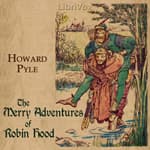

"Come now, let us have a stave all together!" Robin calls to his men somewhere around hour three, and I found myself grinning like an idiot while walking the lakefront at 6 AM, the Chicago skyline just catching the first pink light. There's something almost embarrassingly joyful about Howard Pyle's prose—this Victorian gentleman writing with such unabashed delight in his own cleverness that you either surrender to it or you bail.
I surrendered. Completely.
The Prose Deserves to Be Savored (At 1.0x, Obviously)
This reminds me of what Hemingway said about writing—that prose is architecture, not interior decoration. But Pyle? Pyle would disagree violently. His prose IS interior decoration. Elaborate, gilded, unapologetically ornate. Every sentence drips with "forsooths" and "marry, good fellows" and archaic constructions that my students would hate with the fire of a thousand suns.
I love it.
Pyle wrote this in 1883 as a children's book, but don't let that fool you. The language is dense, the sentences wind through elaborate medieval constructions, and the vocabulary sends you reaching for context clues you forgot you had. This is not background listening. This is not workout material. This is "I'm going to sit with this and let it wash over me" territory. The Great Gatsby demands that same kind of attention—Fitzgerald's prose isn't background noise either.
The structure is episodic—Robin meets Little John, Robin tricks the Sheriff, Robin disguises himself as a butcher, Robin wins an archery contest. Rinse, repeat, with variations. And yes, some listeners find this repetitive. They're not wrong. By hour six, you know the formula: Robin encounters someone, there's a contest or a trick, Robin wins, everyone feasts. But here's the thing—the pleasure isn't in the plot. It's in the telling. Each episode is a little jewel box of language, and Pyle clearly had the time of his life writing every single one.
The Narrator Question (Because There Are Several)
This "various readers" situation is both blessing and curse. David Thorn brings this booming, theatrical energy to the action sequences—when Robin's arrow splits the wand at the archery contest, Thorn's voice swells with genuine excitement. Christopher Cazenove, meanwhile, invests real character work into the voices. His Sheriff of Nottingham drips with aristocratic nastiness, while his Robin carries a lighter, cleverer edge. The contrast between Robin and the nobles isn't just in the text—it's in the vocal performance.
But here's the honest truth: around the halfway mark, the energy dips. One listener described it as "dry," and I understand that. The episodic structure means there's no building tension, no mounting stakes. Robin will win. We know Robin will win. The question is only how delightfully he'll do it this time. If you're listening for plot momentum, you'll struggle past hour five.
I listened for the language. For the way Pyle describes a summer morning in Sherwood. For phrases like "the sweet smell of the fresh green leaves" that somehow don't feel clichéd when delivered with the right conviction.
Why We Still Teach the Classics (Even When They're "Problematic")
Let me be clear: this is a Victorian children's book. The morality is simple. The violence is sanitized. Robin robs the rich and gives to the poor, and we're never asked to consider the economic implications or whether vigilante justice is actually, you know, justice. My students would tear this apart in a modern lens essay.
But that simplicity is also the point. This is where our cultural Robin Hood comes from—the philanthropist outlaw, the noble thief, the man who fights tyranny with a smile and a clever disguise. Kevin Costner's brooding version has nothing on this. Pyle's Robin is genuinely merry. He laughs. He sings. He feasts with his men and treats everyone—from kings to peasants—with the same irreverent courtesy.
There's something almost radical about that joy now. In an age of grimdark everything, of morally gray antiheroes and "realistic" violence, Pyle's unabashed good cheer feels revolutionary.
Who Should (and Shouldn't) Venture Into Sherwood
If you loved The Once and Future King or The Story of King Arthur and His Knights (also by Pyle, and worth seeking out), this is its spiritual successor. If you appreciate audiobooks as performance art—as interpretation, not just reading—the best narrators here deliver exactly that.
But if you need plot momentum, if archaic language makes you twitch, if eleven hours feels like a commitment to a single folk hero—maybe borrow this one from the library first. The episodic structure means you can sample a few chapters and know whether you're in or out.
Denise fell asleep during my enthusiastic recap of the butcher disguise episode. She said it was "charming" in that tone that means "please stop talking about Robin Hood." Fair enough.
Worth Pausing the Faculty Meeting For
This is comfort food for the literary soul. Not challenging, not subversive, not trying to deconstruct anything. Just a Victorian gentleman having an absolute blast writing about outlaws in green, and narrators who (mostly) rise to match his enthusiasm. The prose deserves to be savored. The characters deserve their legendary status. And somewhere around hour eight, when Robin outwits the Sheriff for the dozenth time, you'll find yourself grinning like an idiot too.
My students would hate this. I loved it. That's usually how it goes with the classics.