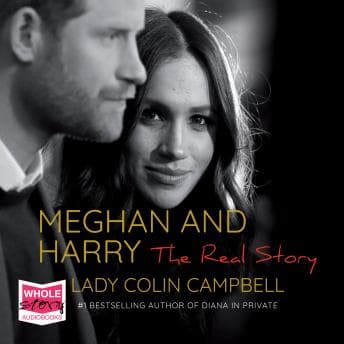

Lady Colin Campbell has a gift — and I mean this in the most complicated possible way — for making you feel like you've crashed a very expensive dinner party where everyone is saying things they'll deny in the morning. I started this one during a long Saturday walk along the lakefront with Denise, who lasted about forty minutes before declaring it 'too much drama for a nice day' and putting her earbuds away. I kept going. Alone. For sixteen more hours. Make of that what you will.
The framing here is 'balanced account,' and Lady Colin does make genuine attempts at fairness — she's not writing a hit piece, exactly. But she has opinions the way a Victorian novel has subtext: constantly, unmistakably, and sometimes overwhelming the actual story. She's clearly done her homework. The royal institutional history is genuinely illuminating, and her analysis of how the Palace machinery operates — the way courtiers manage information, the unwritten rules that govern senior royal conduct — reads like an insider's field guide. That stuff is legitimately fascinating. This is why we still read (or listen to) certain kinds of biography: the access, the context, the sense that someone has actually mapped the territory. Jacqueline Woodson does something similar in Brown Girl Dreaming — that same feeling of a narrator who has genuinely lived inside the material, not just researched it from the outside.
But then she'll veer into conjecture about motivations and inner states, and suddenly you're not reading history, you're reading a very confident guess dressed in authoritative clothing. My students would call this 'citing vibes as sources.' I'd give it a B-minus. The book also jumps around chronologically in ways that feel less like deliberate structure and more like the author following her own train of thought — which is charming in a podcast (I say this as someone whose Faulkner episodes apparently double as sleep aids) but less charming across sixteen hours of audio.
The Voice in the Room — And What It's Doing
Lucinda Bell Howard. Let's talk about what's happening here, because it's genuinely interesting as a narration problem.
The 'smug' descriptor I kept seeing in listener reviews is accurate, but I want to be more precise: it's not that Howard sounds contemptuous, exactly. It's that she sounds knowing. Every sentence lands with the cadence of someone who has already reached the verdict and is now walking you through the evidence. For a book that presents itself as balanced inquiry, that vocal posture creates an odd friction — the narrator's tone keeps telegraphing conclusions the text is still supposedly building toward.
And then there's 'Arki.' Repeatedly, in the early chapters, the name Archie gets rendered as 'Arki' — not once, not as a slip, but consistently enough that I actually stopped walking to check whether I'd misheard. I hadn't. It's a small thing. But small things in audiobooks are like continuity errors in film: once you notice, you notice every time. The narrator understands that pause is punctuation — Howard does use silence effectively in the more dramatic passages — but the mispronunciation chips away at the authority the book is trying to project.
Here's the strange part: despite all of this, the narration didn't ruin it for me. Howard has a certain drawing-room confidence that actually suits Lady Colin's voice. The 'fabulously bitchy' quote I saw in listener reviews? That energy is in the narration too, and sometimes that's exactly right for the material.
Who This Is Actually For
If you're a committed royal-watcher who wants something more analytical than a tabloid recap but doesn't need strict academic rigor, this delivers. Lady Colin knows the terrain. Her earlier work on Diana showed she has genuine access and genuine interest in the institutional dynamics of the monarchy, and that expertise shows here too.
If you're hoping for a fair portrait of Meghan Markle specifically — or if you came here from reading 'Finding Freedom' expecting a counterpoint that takes both sides seriously — you may find yourself frustrated. The skepticism is not evenly distributed.
If you're a casual listener who just wants the broad strokes of the Sussex saga, sixteen hours is a significant commitment for material that circles back on itself. The prose deserves to be savored, Lady Colin would probably say. I'd say: it deserves a tighter edit.
The Annotated Life's Honest Assessment
I teach my students that every text has an argument, whether it admits to one or not. Lady Colin's argument is present from page one, and the book is most interesting when you're reading it with that awareness — not as a neutral account but as a particular interpretation, from a particular woman with particular loyalties, delivered in a particular voice that can't quite hide what it thinks.
That's actually worth something. It just isn't quite what it says on the tin. Worth streaming if you're curious. Not worth a full credit if you're hoping for the definitive account.




![Steve Jobs [unabridged audiobook] audiobook cover](/_next/image?url=https%3A%2F%2Fcovers.audiobooks.com%2Fimages%2Fcovers%2Ffull%2F9788499923406.jpg&w=1920&q=75)